
In early February 1945, as the war moved toward the collapse of the Third Reich, Gross-Rosen did not become more “humane.” Quite the opposite. It was during these final weeks, as everything crumbled, that the cruelty became more blatant than ever. The guards knew that judgment was near. And so, they unleashed their deepest cruelty upon the weakest: the prisoners unable to escape, resist, or even beg for mercy.
Pavel, a Czech schoolteacher, was deported to Gross-Rosen after months of imprisonment and forced labor. Before the war, he taught children to read and write, told them stories, and instilled in them compassion. But at Gross-Rosen, there was no longer any room for the memories of blackboards and chalk. There, there were only stones, hammers, and shouted orders.
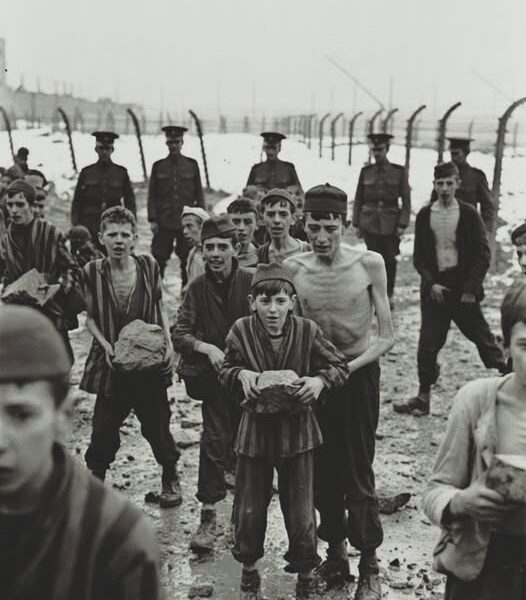
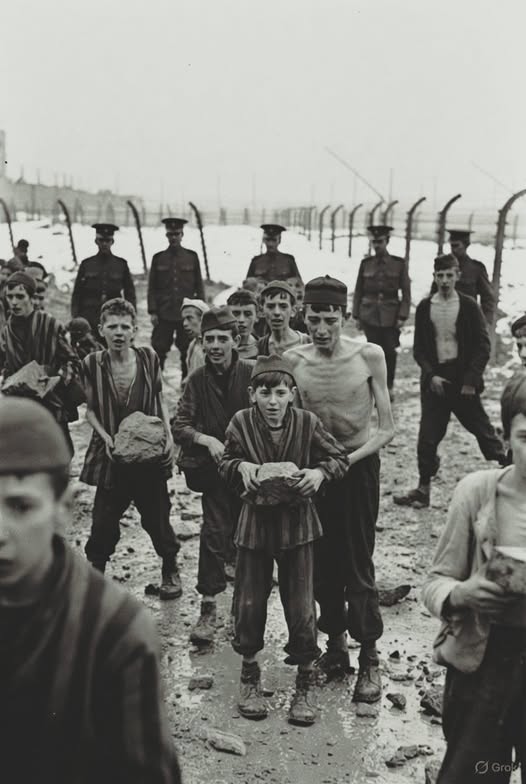
Every day, Pavel and thousands of other prisoners were taken to the quarry before dawn. The Gross-Rosen granite was renowned for its hardness, and that’s why the Nazis had chosen it. They believed that if men were to be subjugated, they should submit to the hardest stone. Slabs of stone, often several times their own weight, were placed on the shoulders of those who were starving, emaciated, and regularly beaten. Every step was an ordeal for their bones, their muscles, and their will.
The winter of 1945 was one of the harshest. A thick blanket of snow covered the ground, but offered no respite. On the contrary, the blood seeped into the cold, white earth, only to seep out more. Pavel’s hooves were worn down. His feet were covered in blisters, then cracks, and finally infections. The open wounds had no chance of healing: every day they were in direct contact with ice, sharp stones, and icy snow.
By early February, these injuries had become a true nightmare. During the endless roll calls, where prisoners were forced to remain motionless, the wounds on Pavel’s legs froze. The blood and pus solidified, clinging to the snow. With every movement, searing pain shot through him to his knee. But the pain wasn’t the most dangerous thing. The most dangerous thing was the inability to stand.
At Gross-Rosen, falling during roll call wasn’t an accident. It was a sentence. The guards surrounded the ranks like predators, watching for the slightest sign of weakness. A tremor, a buckling knee, a hand on the ground: anything could lead to a beating, or worse.
On February 3, 1945, Pavel knew he couldn’t go on any longer. At the cry of “Achtung!”, his body betrayed him. His legs could no longer support him. The world shifted for a brief moment—a moment that, for Gross-Rosen, could have been a matter of life or death.
He leaned forward, nearly collapsing. And at that precise moment, another hand caught him.
The prisoner standing near Pavel said nothing. Speaking was dangerous. Even a glance could be perceived as a challenge. But the man understood immediately what was happening. He tightened his grip on Pavel’s arm, holding him upright, and summoned his last strength. Pavel was heavy, especially now that his body could no longer support itself. But the man held on.
The blood flowing from Pavel’s foot began to seep into the snow. It didn’t just flow; it spread slowly, like a sign no one dared look at. The guards passed by, glanced over, but said nothing. Pavel remained standing. Standing not by his own strength, but by the recklessness of another.
This moment lasted only a few minutes, perhaps barely, but in the distorted time system of the concentration camp, it seemed like an eternity. Every passing second made Pavel’s heart pound. Not the fear of pain. Not the fear of death. But the fear that the person beside him would be discovered.

At the end of the call, Pavel was still alive. For Gross-Rosen, it was a victory.
In the days that followed, Pavel was integrated into the evacuation column as the Allies advanced. He trudged through this death march, haunted by the memory of the arm that had kept him upright. He didn’t know the man’s name. He didn’t know where he came from. But Pavel knew one thing: without that moment, he wouldn’t have survived.
The man who had supported Pavel did not survive. A few days later, he was beaten to death because he had become unable to work. There is no headstone. No complete records. Only the memory of a survivor.
When Pavel was liberated, he weighed less than 40 kilos. But the heaviest burden wasn’t his body. It was the realization that he had lived at the cost of a silent sacrifice. Years after the war, when asked what haunted him most in the accounts of Holocaust survivors , Pavel mentioned neither the guards, nor the whippings, nor the hunger. He spoke only of “the weight of another human being.”
“At Gross-Rosen,” Pavel said, “I learned how much weight a human being can carry. And I also learned how precious life becomes when you accept that weight.”
Pavel’s story is not found in traditional textbooks. It lacks dramatic and shocking details. But it is precisely for this reason that it so accurately reflects the nature of human resilience during the Holocaust . Resistance does not always take the form of weapons or riots. Sometimes, it is simply an outstretched hand that prevents someone from succumbing.
Gross-Rosen tried to petrify humanity: to make it cold, heavy, and lifeless. But it was precisely in this place, amidst the granite dust and blood-stained snow, that moments emerged, revealing something that even a brutal empire could not destroy: the human capacity to help one another, even at the cost of their own lives.
And it is perhaps precisely these moments that make history not only a chronicle of atrocities, but also a reminder that even in the darkest depths of World War II history , humanity can still exist — fragile, silent, but indelible.
Note: Some content was created using AI (AI and ChatGPT) and then reworked by the author to better reflect the historical context and illustrations. I wish you a fascinating journey of discovery!