CAUGHT ON TAPE: Democrat’s ‘Accidental’ Confession Sparks National Demand for Treason Charges Against the ‘Seditious Six’ 🚨

WASHINGTON D.C. – The facade has finally crumbled. In a stunning moment that is being described as a “political death wish,” a key member of the infamous “Seditious Six” has seemingly
ACCIDENTALLY REVEALED the dark truth behind the Democrat establishment’s coordinated war on Donald Trump.
The viral clip, which opponents are trying desperately to scrub from the internet, shows Senator Mark Kelly in an unguarded moment that critics say exposes the
TRUE MOTIVATION behind the Anti-Trump agenda: it was never about “saving democracy”—it was about holding onto power at all costs.

I. THE MASK SLIPS: AN ADMISSION OF GUILT?
For years, the American public has suspected that the coordinated attacks against President Trump were part of a scripted narrative. Now, we have what looks like the smoking gun.
In the video, the Senator appears to drop the “patriotic” script, revealing a calculated, cynical strategy designed to manipulate voters and weaponize the government against a political rival. This wasn’t a gaffe; this was a
CONFESSION. The admission has ignited a firestorm, with legal experts and patriots alike arguing that this moves beyond political dirty tricks and enters the realm of SEDITION.
II. WHO ARE THE ‘SEDITIOUS SIX’?
The term “Seditious Six” is now trending nationwide, branding the group of lawmakers accused of orchestrating this plot. They are no longer seen as mere representatives, but as a
CABAL operating against the will of the people.
Critics argue that their actions—coordinated smear campaigns, alleged weaponization of intelligence, and now, admitted manipulation—fit the textbook definition of CONSPIRACY. The narrative is clear: They didn’t just oppose a President; they tried to overthrow the voters’ choice through deception.
III. PROSECUTION TIME: NO MORE EXCUSES
The image circulating online says it all: “PROSECUTION TIME.”
The American base is done with hearings and sternly worded letters. The demand is now for
-
The Charge: If these lawmakers knowingly lied to the public and coordinated to subvert an election or damage a sitting President based on false pretenses, they must face
FEDERAL CHARGES.
-
The Consequence: Calls are mounting for the immediate DISBARMENT and IMPEACHMENT of everyone involved in the “Seditious Six.”
IV. CONCLUSION: JUSTICE CANNOT WAIT
The accidental revelation has validated the worst fears of the American electorate: The system is rigged, and the people running it have been lying. But now, they have been caught.
The question is no longer “Did they do it?” The question is: “Will the Department of Justice do its job and ARREST the conspirators?”
Do you support federal PROSECUTION for the ‘Seditious Six’?
The Senate’s Decisive Action

In a rare display of bipartisan unit y that has become increasingly uncommon in today’s polarized political landscape, the United States Senate has delivered a resounding message about America’s energy priorities. The overwhelming support for a groundbreaking piece of legislation signals a fundamental shift in how the nation approaches one of its most critical infrastructure challenges, setting the stage for what could be the most significant transformation of the American energy sector in decades.
The Senate’s Decisive Action
The U.S. Senate voted overwhelmingly to pass a key piece of legislation to bolster the country’s nuclear energy sector. This decisive action represents one of the most significant steps toward energy independence and technological advancement that the chamber has taken in recent years.
The bill passed by a vote of 88-2 with Sens. Ed Markey (D-Mass.) and Bernie Sanders (I-Vt.) opposing the measure. The nuclear package was combined with another bill that reauthorized the U.S. Fire Administration and grant programs for firefighters. This combined package will also go to the president’s desk, demonstrating the Senate’s ability to address multiple critical infrastructure needs simultaneously.
The margin of victory – with only two senators in opposition – underscores the broad consensus that has emerged around the need to revitalize America’s nuclear energy capabilities. This level of bipartisan support is particularly noteworthy given the historically contentious nature of nuclear energy policy and the deep political divisions that characterize most legislative debates in Washington.
A Comprehensive Approach to Nuclear Modernization
The measure aims to speed up the process of approving the construction of new nuclear plants as many of the country’s existing plants reach the end of their serviceable lives. In addition, it cuts the licensing fees that power companies must pay to begin projects. It also mandates the Nuclear Regulatory Commission to prepare a report examining ways to simplify and expedite the environmental review process.
These provisions address some of the most significant barriers that have hindered nuclear development in the United States for decades. The current regulatory framework, while designed to ensure safety, has created a cumbersome approval process that can take years or even decades to complete, making nuclear projects prohibitively expensive and time-consuming compared to other energy sources.
By reducing licensing fees, the legislation directly addresses one of the financial obstacles that have deterred private investment in nuclear technology. These fees, which can run into the millions of dollars even before construction begins, have particularly impacted smaller companies and innovative startups that are developing next-generation nuclear technologies.
“It will be history-making in terms of small modular reactors, which is the future of nuclear,” Sen. Shelley Moore Capito (R-W.Va.) told reporters. This statement highlights one of the most significant aspects of the legislation – its focus on enabling the deployment of advanced nuclear technologies that promise to revolutionize the industry.
Small modular reactors (SMRs) represent a paradigm shift from the massive nuclear plants that have dominated the industry for decades. These smaller, more flexible units can be manufactured in factories and transported to sites, potentially reducing construction costs and timelines while maintaining the same safety standards as larger facilities.
The modular design of these reactors also offers significant advantages in terms of scalability and deployment flexibility. Unlike traditional nuclear plants that must be built as single, massive installations, SMRs can be deployed incrementally, allowing utilities to add capacity as demand grows and reducing the enormous upfront capital investments that have made nuclear projects financially challenging.
Industry and Expert Perspectives
Supporters of the measure say it’s a tremendous boost for the nation’s nuclear power sector. The legislation has garnered praise from across the energy industry, with stakeholders viewing it as a critical step toward making nuclear power more competitive with other energy sources.
“It’s a facilitator of the process by which industry has to get approvals for building these projects,” Lesley Jantarasami, managing director of the Bipartisan Policy Center’s energy program, told The Hill. This assessment reflects the broader industry view that regulatory streamlining, rather than regulatory weakening, is essential for nuclear energy’s future viability.
The support extends beyond traditional nuclear i ndustry advocates to include environmental groups and clean energy advocates who see nuclear power as an essential component of efforts to reduce carbon emissions and combat climate change. This evolving coalition reflects a growing recognition that achieving ambitious climate goals may require all available clean energy technologies, including nuclear power.
House Support and Bipartisan Momentum
The vast majority of House members also advanced the bipartisan nuclear-fire bill, in a 393-13-1 vote, with Rep. Rashida Tlaib, a far-left Michigan Democrat, voting “present” to show support for the fire provision but opposition to the nuclear portion. This overwhelming House support demonstrates that the pro-nuclear consensus extends across both chambers of Congress.
The House vote, with only 13 members in opposition, represents an even stronger showing than the Senate vote, suggesting that support for nuclear energy expansion has broad geographic and ideological appeal. The fact that the legislation combined nuclear provisions with firefighter support also illustrates the strategic packaging that helped build such overwhelming support.
BREAKING: $500M SHOPPING MALL COLLAPSES

BREAKING: $500M SHOPPING MALL COLLAPSES

Learning from Seoul\’s Sampoong Department Store disaster – a history of cities in 50 buildings, day 44This article is more than 10 years old
After a string of ill-considered decisions led to the collapse of Seoul’s luxury department store and the death of 502 people in 1995, the disaster continues to offers an important lesson to other cities urbanising at such an impressive pace
Colin MarshallWed 27 May 2015 14.27 BSTShare 16
Observers tend to describe the rise of South Korea as a miracle, and the actual story makes the word seem only a minor exaggeration. Having emerged an utter wreck from the Korean War in the early 1950s, by the 21st century the country had become a rich, infrastructurally impressive, technologically forward-thinking global economic and cultural force. But South Korea’s unprecedentedly rapid entry into the first world has taken its tolls, and no one event of its dizzying 20th-century period of growth forced as many of its people to face them as the collapse of the Sampoong Department Store.
Those who endured the hardships of the Korean War and its aftermath had to welcome whatever prosperity the future could bring, despite the repression of the dictators who oversaw it and the grinding nature of a national life rigorously dedicated to nation-building. But from the 1970s through to the early 1990s, even the most development-minded Korean couldn’t help but suspect that something had gone wrong. An apartment block falls to the ground, a hotel catches fire, a train station explodes, a bridge collapses: the built environment that had risen so recently and triumphantly around them had already begun to crumble.
From the beginning, South Korea has understood that development and urbanisation go hand in hand. In fact, it understands that almost too well, resulting in what ranks today as one of the most capital-centric countries in the world. The resources it has devoted to Seoul make the rest of South Korea seem almost like a mere support system for that 24-hour high-rise megalopolis of 25 million people, built over the rubble of the modest Japanese colonial city it had been before the second world war.
The creation of postwar Seoul involved plenty of rebuilding, but even more new building. The “old” city lies north of the Han River, which runs through Seoul much as the Thames does London. On the Han’s other side, the area known as Gangnam (literally, “south of the river”), made famous in recent years by pop music and television dramas, has grown since the 1970s as a deliberately designed hub of private affluence, corporate investment, and skyline-defining towers – a concrete advertisement for just how far up South Korea has come in the world.
A former landfill in Gangnam’s especially wealthy district of Seocho made the perfect location for the upscale Sampoong Department Store. Construction on this bright pink symbol of Seoul’s advanced consumer culture began in 1987, the year South Korea became a democracy and the year before the modernised country made its debut on the world stage by hosting the Olympic Games.
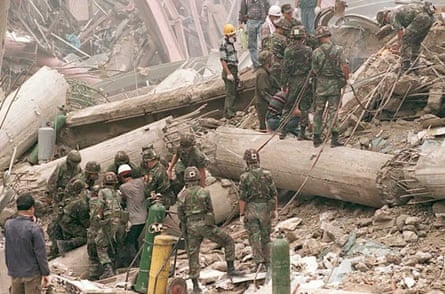
US and South Korean soldiers look for survivors in the rubble: 502 people died, and almost 1,000 were injured in the collapse. Photograph: Choo Youn-Kong/AFP/Getty Images
But it didn’t enter construction as a department store: the original plan called for a large four-storey apartment complex. After work had already begun, owner Lee Joon, in the first of many ill-considered decisions, switched the project from a residential one to a commercial one, a conversion which necessitated the removal of support columns to make room for escalators. When the contractors balked at this, Lee exchanged them for a more obedient in-house crew.
Using a building of this size entirely as a department store went against zoning regulations, which Lee circumvented by ordering the addition of a skating rink on an originally unplanned-for fifth floor. Again, when the first building company he hired advised against such a structure-compromising modification, he simply sacked them. The firm that did build the fifth floor even went along when he changed his mind once again, turning it into a gallery of restaurants heated by a system of under-floor hot-water pipes, increasing the stress on the already overburdened columns remaining.
Still, the Sampoong Department Store might stand today if not for the air-conditioning machinery installed on top. When tenants of neighbouring buildings to the east complained about the noise it made, management moved the three units to the west, not by lifting them with cranes, but by dragging them – their combined 45-tonne weight four times what the building was designed to handle – all the way across the roof. This opened up cracks that widened each and every morning the air conditioners clicked on and vibrated to life over the next two years.
Then came the morning of 29 June 1995. The structure’s visible cracks had widened alarmingly and continued to do so as the day wore on, provoking enough concern to force two executive decisions: first, to switch off the air conditioning, and second, to close the top floor. But Lee refused to evacuate the day’s unusually large and lucrative shopping crowd, and so in the store they remained at 5:52 pm, when the air-conditioning units fell through the roof and the support columns gave way, resulting in the deadliest building collapse since antiquity.
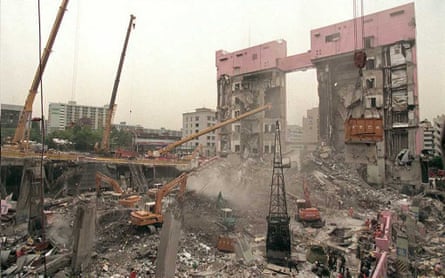
View image in fullscreenInspections after the collapse revealed that just one-in-50 of Seoul’s towers were safe. Photograph: Kim Jae Hwan/AFP/Getty Images
More than 500 people died in the Sampoong Department Store – not because of a gas explosion or a North Korean bomb (two early suspicions) – but because of sheer negligence in construction and maintenance of a building not yet six years old. As the facts emerged, Lee and his associates became the most reviled men in South Korea, not just for their own actions (most damningly, their selective evacuation of Sampoong’s executives from the building, hours before the collapse) but for the shameful strain they represented in the country’s modern history: their reckless corner-cutting, bribery and irresponsibility, far from isolated tendencies, had become endemic in a society desperate to develop as rapidly as possible, a sensibility which renders the law nothing more than an obstacle to prosperity.
“Endless Disaster, Disaster, Disaster,” declared one local headline in the wake of the Sampoong collapse. Not only had the public caught on to that pattern, but the investigation of the Sampoong Group and the government officials with which they dealt threw light on a staggering depth and breadth of corruption. Worse still, the thoroughgoing inspection of Seoul’s by then proudly characteristic towers found that one out of seven needed rebuilding, four out of five needed major repairs, and just one in 50 could qualify as safe.
“People should do their best at their jobs,” said Jeong Gwang-jin, a prominent lawyer who lost three daughters in the Sampoong Department Store. “This accident happened because they didn’t.” The prioritisation of size and quantity over safety and quality demanded by South Korea’s ideology of accelerated nation-building, expressed as a practice of accelerated city-building, visited this resoundingly third-world accident on Seoul’s newly minted upper-middle class.
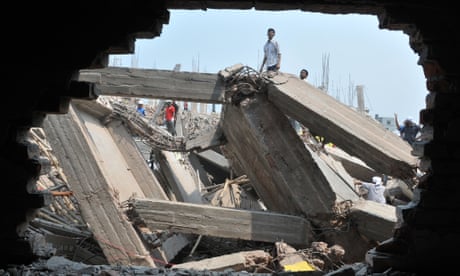 Reliving the Rana Plaza factory collapse: a history of cities in 50 buildings, day 22Read more
And Lee, born in 1922, would have come of age in a time when Korea was a land that still relied to a great extent on horse carts and thatched roofs, one where nobody considered the prospect of opulent shopping complexes, let alone of the prospect of opulent shopping complexes suddenly falling down. Like most of South Korea’s ruling class in the 1970s and 1980s, Lee found himself in a position of power in a reality almost incomprehensibly different from any he’d known before, with a mandate only to generate wealth, and he made decisions that reflected his circumstances.
The story offers a lesson to all the cities currently and dramatically expanding in developing countries over the world, most notably China, where the impressive and frightening aspects of South Korea’s development now play out on a larger scale and shorter timeline. It also continues to offer a valuable lesson for South Korea. Despite the insistence that a Sampoong Department Store must never happen again, a similar disaster did indeed happen again: last year, this time at sea rather than in the city. On 16 April 2014, 304 passengers, many of them high school students, died in the sinking of the badly overloaded, procedurally unprepared MV Sewol, a tragedy which echoed not just Sampoong but the earlier MV Seohae, another ferry which claimed 292 lives when it went under in 1993.
On the whole, South Korea has built a formidable city in Seoul, and one that will serve ably as a model for other countries looking to craft world-class urban environments of their own. If a living city is a changing city, Seoul counts as one of the most intensely city-like cities going today. Seoul seems to remain in a constant state of architectural and infrastructural metamorphosis – and not always because pieces have fallen off. But that constant revision of the built environment can also feel like an erasure of history. Visit the site of the Sampoong Department Store, and you’d never guess what happened there almost exactly 20 years ago – a luxury apartment complex now stands in its place.
Which other buildings in the world tell stories about urban history? Share your own pictures and descriptions with GuardianWitness, on Twitter and Instagram using #hoc50 or let us know suggestions in the comments below
Rana Plaza: one year on from the Bangladesh factory disasterThis article is more than 11 years oldAfter last year\\\’s disaster people blamed the factory owners, builders, or the government – but isn\\\’t the real culprit our demand for cheap clothing?
For a very brief moment, just before daybreak, the narrow backstreets are empty. Trucks still rumble down the potholed road through the town but the last workers have long gone home, walking past the furled awnings of the market stalls, over the single footbridge, along the battered pavements, to the tenement apartments, the squalid huts, the tin-roofed homes by the fetid pond.
Then, as light comes, the silence is broken: water splashes into a bucket held under a standpipe by a child, a pressure cooker wails, someone laughs. In thousands of homes, tens of thousands of people are scooping rice and vegetables from tin bowls, packing the leftovers to eat during the long day ahead and then, hands rinsed, goodbyes said, filing out into the streets, the streams of workers uniting and then separating as they flow through the town, like blood through veins, each leading to a different factory. In the evening the flow will reverse, the pulse slower, less certain. But now, at 7.30am, it is sure and steady.
On this morning, 23 April last year and the day before the disaster, the workers at the five factories housed in the eight-storey Rana Plaza arrive as usual around 7.45am. There are 2,200 registered employees in the complex, plus those who staff the bank and the shops on the first floor. Once through the doors at the rear, they head up the narrow stairs to their workplaces: New Wave Bottoms on the second floor, Phantom Apparels on the third, Phantom Tac on the fourth, then Ether Tex and finally New Wave Style on the sixth and seventh floors. For several years now, these five companies have produced millions of items of clothing for western clients including Matalan and Primark.
Among the workers is Mahmuda Akhter. Her husband, Habibullah, works in the Phantom Tac factory a floor above, and as usual the couple have walked to work together, leaving their baby girl at home with Mahmuda\\\’s mother. They are from a small village in Pabna district 100 miles from Savar. Unusually for conservative Bangladesh, theirs is a “love marriage”, not arranged by their parents. Mahmuda is 20; Habibullah, 23.
Mahmuda reaches her sewing machine and sits down. A few yards away is Shapla Begum, a supervisor working on another of the three lines, each of around 80 sewing machine operators, that constitute Phantom Apparels. Shapla is 27 and has been in Savar for five years. She, too, is a migrant. Her husband\\\’s earnings as a rickshaw puller in their village in Kurigram in the distant north were insufficient to pay for schooling for their two boys so, following other relatives, they came to Savar.
Working for Ether Tex on the fifth floor are Runarini and her two daughters. Runarini is a “helper”, cleaning and carrying, as is the younger of the two girls, Preity, who is 15. The elder, 18-year-old Shamapati, a serious girl who laughs rarely, says little and works hard, is a sewing machine operator. The trio have arrived in Savar more recently than most of their colleagues and so can afford only a single room in a battered, tin-roofed shack. They hope that in time they will find something better. The open yard full of chickens and children in front of their new home reminds Preity of the fields and trees she left behind, and of the friends she misses.
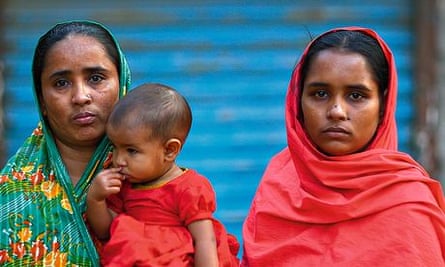
Mahmuda Akhter, with her mother and daughter. Her husband, Habibullah, who also worked at Rana Plaza, was killed. Photograph: David Levene for the Guardian
But she likes Shonjit Das, the 19-year-old son of her immediate neighbour. He works in the finishing section of Ether Tex, packing the clothes to be sent off to the west, and is handsome and funny, and sometimes walks her home at the end of the day. And she knows the three women are earning many times what labouring in others\\\’ fields or cultivating their own poor, eroded land back in their village would ever have paid.
At 8am, as every morning except Sundays, in all the factories, on every floor of the Rana Plaza, the bell sounds, conversation ends and work starts.
No one is entirely sure how big the global clothing industry is, what profit it makes or how many it employs. It is estimated that $300bn worth of clothes were made by the top 10 producers in 2012, and the industry as a whole generates revenues of between $500m and $2tn. But no one really knows.
Textiles, if not garments, have always been a key element of global commerce. For more than a thousand years, trade between Europe and east Asia travelled what were known as the “silk routes”. Later, the textile industry played an important role in Britain\\\’s emergence as the world\\\’s leading commercial power. There and elsewhere, the rag trade employed millions and created immense wealth, playing a key role in the transition of western nations from agrarian to industrial economies. But nothing really compares with what is happening today, either in scale or in impact. For as the west has got richer, its demand for clothes has steadily risen.
Garment-making is labour-intensive and there is often little room for savings on the textiles that are the biggest single cost. This means the price of a human being cutting, making and trimming a garment is key in the overall production costs and, of course, eventual profits. Through the 50s and 60s, producers hunted cheaper labour in east Asia – first Japan and then, in the 70s and 80s, in the so-called Asian Tiger economies of Hong Kong, Singapore, South Korea and Taiwan. Employment in the garment manufacturing industry in the west has declined steadily decade on decade – despite attempts to protect local industries with quota systems and tariffs. Production in newly industrialised China, as well as in Indonesia, Turkey, Mexico and India, has increased exponentially.
For the consumer, of course, this has all meant that while prices of everything else except communications have risen, clothes cost less. In 1900, 15% of a US household\\\’s income was spent on clothing. In 1950, it was still 12%. Even as late as the early 1990s, major purchases of clothing – a suit, a dress, a coat – marked a special occasion or a rite of passage. But by 2004, the total amount spent by households on clothes had dropped to just 4%. By 2010, according to the US Bureau of Labour Statistics, clothing cost the average American family only $1,700 (£1,017), 2.8% of their income. And for that money the consumer gets much more. Cheap no longer means nasty; it just means affordable. In 1997, the average woman in the UK bought 19 items of clothing a year; in 2007, she bought 34.
The big bang in recent textile history came in a few short years at the beginning of the last decade, when various factors coincided to change radically the nature and scale of garment production around the planet. One was the end of the quota system put in place 30 years earlier to protect western industries. A second was a new degree of conformity of tastes across the world, allowing greater uniformity of product and bigger volumes of single designs. A third was “fast fashion”.
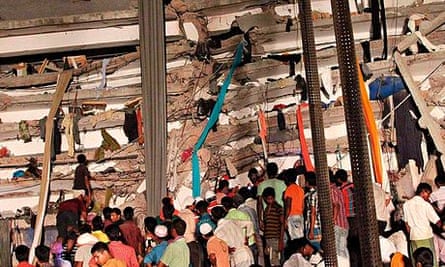
Volunteers and rescue workers search the rubble for trapped factory employees. Photograph: Palash Khan/Sipa USA /REX
Fast fashion is at once a mode of production, a strategy and a style. It grew out of the efforts of the major western brands, which dominate garment sales, to find new ways to coax further demand out of a saturated market. Though soon adopted by retailers across the world, it was pioneered by Inditex, the giant Spanish company that owns Zara. It depends on a series of mutually reinforcing innovations: an accelerated cycle of design, production and supply that means trends can be spotted, copied and sold within weeks; no “seasons”, but a year-round product flow; low stock levels in stores to encourage rapid, repeated impulse purchases; a supply chain that can respond when shop staff notice that shoppers suddenly seem to like lace, or blue, or diamond patterns, or a particular stitching on their socks, or whatever; huge numbers of young adults for whom shopping is the primary leisure activity; a new obsession with celebrities, fuelled by social media and the internet; and, of course, low prices.
Sourcing has thus become a complex operation in which scores of different factors – cost, location, eventual market, risk, competition, styling, quality and so on – are computed to decide on an eventual place of production. Basic clothing – socks, for example – will be ordered in huge quantities with long lead times. Higher quality workmanship will be done in Europe, north Africa or, for the US market, Latin America. More fashion-led items are often needed in smaller quantities but faster. And cost, whatever the brands say, is always the prime consideration. So in this highly networked system, places where suppliers can turn around vast quantities of clothing very rapidly and very cheaply are key. Places where you can order, say, 500,000 basic shirts, paying $6 per piece, and they will be shipped on time, with minimum fuss, and be in stores, retailing for $30, within, at the outside, two to three months. Places such as Bangladesh.
Mahmuda and her husband are standing in a crowd of workers outside the Rana Plaza complex. They have been there for nearly 40 minutes and now 2,000 people are massed around the building. Shapla is there, too, and Preity, her mother and sister, and Shonjit, her 19-year-old friend. There is a low murmur of discontent and concern.
It is 24 April. The previous day, shortly after work started, three cracks were found in the reinforced concrete pillars that support the eight-storey building. An engineer sent by the Savar municipality declared the building unsafe, work in the five factories was halted and everyone was sent home.
Mahmuda\\\’s job is to stitch seams and pockets. It is one of the tougher of the 60 or 70 separate operations needed to make a pair of trousers. She is supposed to stitch 120 pairs an hour, 10 hours a day, six days a week, 50 weeks of the year. That\\\’s 360,000 annually. She earns 8,000BDT (£60) each month. Her husband, a quality controller, earns a little more.
Each line in Mahmuda\\\’s factory is watched over by three supervisors. Shapla is one of only a handful who are women. She is paid 10,000BDT (£75) for monitoring the 15 workers and five helpers on her section, but gets no overtime. The line\\\’s target and their progress is indicated on a board hung on the wall above the output bins where the finished clothes are dropped. The workers get an hour off for lunch. The boss “is a well-mannered person” and there are no complaints, or at least not from Shapla\\\’s section.
If an order is delivered late, accepted practice in much of the industry is for the buyer to deduct 5% for each week of delay. The buyers already have political unrest, wildcat strikes and blockades to deal with; they cannot afford to risk losing further days of production.
And that is what they are facing now.
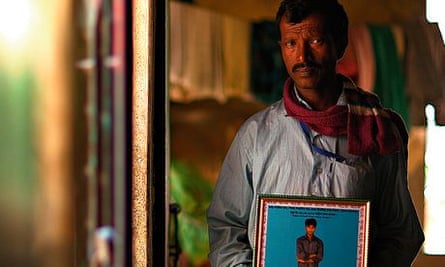
Satyadip lost his 19-year-old son, Shonjit, in the building collapse. Photograph: David Levene for the Guardian
Which may explain how, somehow, overnight, the cracks that shut the factory the day before have become less dangerous and the management has called in the workforce. The building has been inspected once more and is safe, they say. Monthly salaries are due in 10 days, but overtime, which increases most employees\\\’ salaries by between a third and a half, and means being able to pay the rent or eat properly, will be paid in the next day or so. Many of the workers are told by their managers that unless they work, they will not receive the money. What choice have we got, the workers are saying to each other. We are here to work, after all.
The managers know this. They know, too, that, as a female supervisor, Shapla is trusted more than her male counterparts, and not just by “her girls”. So when they want the workers to stop shouting and calm down, and to enter the building, take their places at their machines and finish the big orders the factories are currently under pressure to complete on time, several come to her, telling her again how the building is safe, how the girls trust her, how if she doesn\\\’t go in, the girls won\\\’t either. She is uncertain, reluctant, but because at that moment it is the easiest thing to do, she gives way and goes in. And her girls follow.
Similar pressure has been put on other supervisors. They, too, reluctantly head into the building. Soon all the workers are flowing up the stairs. Mahmuda leaves her husband in the stairwell. He carries on up to his factory. She makes her way to her desk and machine on the third floor. On the fifth floor, in the Ether Tex factory, 15-year-old Preity, her mother and her sister are working by 8.30am. Preity is on her feet, moving up and down the line, clearing offcuts, bringing new needles or thread; her mother is nearby, her sister working at a sewing machine on the same line but at the opposite end of the room.
Mahmuda has time to stitch maybe two or three pieces before the lights go out, the old fans, which barely dent the heat in the factory, slow and the sewing machines stop. A power cut, frequent enough and no cause for alarm. The workers wait in the gloom, talking quietly, worried, waiting for the powerful, heavy generators installed on the roof to start up.
Moments after the generators start, sending vibrations through the building, a pillar in one corner of the Rana Plaza gives way with a loud, explosive bang. Then each storey slides sideways, tips and splits, falling in on the one below. On the third floor, the collapse is almost instantaneous, but the workers of Phantom Apparels still have time to realise what is happening.
The floor starts shaking and it is clear the building is coming down. Mahmuda starts reciting verses of the Qur\\\’an. She staggers, falls and crawls beneath her sewing machine.
Shapla is walking down her line when the building starts to collapse. She starts running. She, too, seeks protection under a sewing machine and then everything gives way around her. She is in darkness, gasping for breath.
Two floors above, the floor inclines slowly like the deck of a sinking ship. Panicked workers rush to the two narrow exits. It is dark, there is much dust and noise. Runarini has managed to find her youngest daughter, Preity, and is now trying to get to the other end of her line where Shamapati, her eldest, was working at her machine. But the force of bodies pushes her towards the exit. She cannot hold on to Preity and fight the crowd to find Shamapati. The floor lurches, tips again and everything falls.
In the darkness after the collapse there are many voices: sobs, sustained screaming, calls for help and water, moans of pain, prayers, howls of grief. Some are trapped in total darkness, others can make out some light. Many are pinned down by huge blocks of concrete, bent iron girders, machinery. Others are entombed in small cavities. Some are alone, others with colleagues or strangers from other floors. Shapla can move her hand but nothing else. Mahmuda can see the sky through a gap in the wall several yards away. Runarini and Preity are trapped together and they can hear voices, but not Shamapati\\\’s. They shout her name, but there is no response.
Outside there is chaos. Dazed survivors stand immobile in a huge, roiling cloud of dust. It takes time for Dhaka\\\’s ramshackle emergency services to arrive, so hundreds of locals clamber over and through the rubble, tearing at the concrete blocks and mangled metal with their hands. Soon corpses are lined up on the ground, limbs limp and twisted, as if they had fallen from a great height. Mahmuda crawls towards the light, finds herself only a few metres from the ground and clambers down. She cannot see her husband.
Shapla waits longer for rescue. She can hear sirens and shouts outside. They are hammering and drilling the slab of concrete above her. She finds her throat so dry from screaming that she cannot talk when the rescuers find her. She is unaware that she has made any noise whatsoever. It takes two hours to free her.
Runarini and Preity crawl together towards a shaft of light and are lifted from the rubble by mid-afternoon. The ruined building is now surrounded by police and soldiers, and heavy lifting equipment is arriving. There are electric saws and jackhammers, and lines of ambulances. There is no sign of Shamapati.
Bangladesh is the original “basket case”, a term coined by Henry Kissinger, the US secretary of state, to describe the country immediately after its violent secession from Pakistan in 1971. Up to 3 million died in that conflict, a civil war that was simultaneously a war of independence, and its wounds remain livid. Famine, flood, a massive programme of nationalisation, political instability and further violence crippled the new nation\\\’s economy. But, despite the continual challenges, the textiles and garment industry prospered. Investment and advice from Korean companies helped and, by the end of the 1990s, the industry had somehow weathered destructive storms – political, economic and meteorological.
In 2004, when the protectionist quotas that had been imposed to protect western jobs 30 years earlier expired, many in Bangladesh were apprehensive. But the industry boomed. “Business just took off,” says Rubana Huq, now managing director of garment manufacturers the Mohammadi Group. In 2004 there were 2 million workers in Bangladesh\\\’s 4,000 factories, with exports worth $6bn. Nine years later, there were twice as many in 5,600 registered establishments, sending $21bn worth of clothes overseas.
Competition from abroad when the quotas disappeared meant “prices dipped”, Huq says, but the demand from Europe and the US was so great that she and others “just kept on building”. If wages in Bangladesh remained the lowest in the world, land prices in central Dhaka, where most of the garment businesses were based, rose so fast that new investors sought space on the margins of the city where hastily reclaimed wetlands could still be bought relatively cheaply. In Savar, Gazipur, Ashulia and elsewhere around Dhaka, hundreds of factories went up every year. There was little or no planning or regulation.
“People were not much concerned by building codes or quality of material,” admits Emdadul Islam, the long-serving chief engineer of Rajuk, Dhaka\\\’s development authority. Monitoring of environmental impact, construction quality and permits for the millions flowing in from rural areas were almost nonexistent.
Inevitably, people started to die. In April 2005, a factory in Savar called Spectrum collapsed, killing 64 workers. The dead were making clothes for western retailers. Poor cement was a likely cause – builders often charge for better-quality materials than they deliver – or water from a nearby canal may have washed out foundations. For a short period there was talk of a crackdown on unsafe buildings, but even though a second factory in northern Dhaka collapsed a year later, killing 21, the fuss faded. As the recession hit western economies in 2008 and 2009, brands forced down prices even further as they negotiated with suppliers. Those in Bangladesh who demanded government intervention in one of the country\\\’s few economic success stories made little headway when dozens of garment factory owners sat in parliament and powerful industry bodies had the ear of policymakers. The boom continued. Bangladesh, the world\\\’s 76th biggest exporter of clothes in 1980, was the eighth biggest in 2006, and by 2013 was second only to China.
Over the decade, prompted by a string of reports of child labour and other abuses in factories around the world, the brands had set up systems to monitor pay and working conditions in their supply chain. Some organised their own inspections, many brought in contractors. But executives did not think to undertake structural surveys of the buildings where their clothes were made. Instead, they relied on the corrupt, poorly paid, underqualified, undermanned local authorities. This, senior executives at major European brands now admit, was a mistake. Others use stronger terms. From 2005 to March 2013, fires killed an estimated 600, but no more buildings collapsed.
The Dhaka suburb of Gulshan is only 15 miles from Savar. Rickshaws negotiate its quiet, tree-lined streets with relative ease and there are many good restaurants. In the late morning, coffee shops are busy with staff from international NGOs and the UN. This is where the Bangladesh operations of many big European and US brands are based, as are the larger buyers who often act as their intermediaries locally.
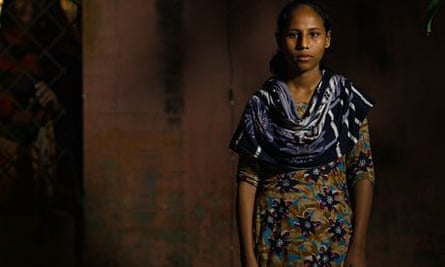
Fifteen-year-old Preity and her mother managed to escape from the building; her 18-year-old sister Shamapati didn’t make it out. Photograph: David Levene for the Guardian
The offices of H&M occupy a new five-storey block. There is nothing to distinguish the building, inside or out, from its counterparts in any western capital. On the walls of brightly lit meeting rooms – each named after garment manufacturing zones around the city – are posters of laughing, thin, beautiful young Europeans of varying ethnic backgrounds wearing the bright, cheery, fashionable clothes of the company\\\’s brands. A notice tells staff: “Your passionate focus towards quality will make it happen.”
H&M, which has 3,000 stores in around 50 markets worldwide and sales of £13bn in 2012 (making a profit of £1.6bn), has been in Bangladesh since the early 80s and is one of the biggest foreign brands working in the country. The Swedish retailer did not have any contracts with the factories working in Rana Plaza, nor any link to the building, and has long been at the forefront of efforts to find a way to improve pay and working conditions in the industry. These have intensified since last April\\\’s tragedy, but “there\\\’s a lot more to the country for us than low wages and low costs”, says Anna Gedda, the company\\\’s social sustainability manager.
Executives from other big brands all make similar points when talking about the Rana Plaza collapse, even if their companies have been less proactive than H&M. They express their shock and grief, say they have long recognised the problems in Bangladesh, point out that the chaotic environment of a developing world city means many issues are partly beyond their control (though, they admit, still their responsibility), and downplay the significance of cheap labour in the decision to locate production in the country. They also emphasise the importance of the garment industry to the Bangladeshi economy and the social transformation brought about by the employment of millions of young, rural women, albeit in poorly paid, monotonous jobs. One company spokesman points out that otherwise “these women would be in the fields, in ship-breaking or shrimp farming, working as maids”. Now, he says, they are breadwinners, independent, and often with the means to pay for their kids to go to school.
H&M\\\’s Gedda says: “The best way for the country is for brands like H&M to stay there.” This is something one hears frequently: from the Bangladesh Garment Manufacturers and Exporters Association, senior ministers, international trade unionists, independent economists and urban development specialists in Dhaka. It\\\’s also what all the workers say. Everyone agrees that the Rana Plaza collapse was a “wake-up call” that will be “a turning point”, but they all say the industry and the brands must remain. “If there is a pull-out, it will be a catastrophe for Dhaka,” says Professor Nazrul Islam, of the local Centre for Urban Studies.
The result, after a series of fairly acrimonious meetings in Geneva and Paris last year, is three separate initiatives: the Accord, which involves more than 150 largely European brands; the Alliance, set up by US brands; and a joint effort by the UN and the Bangladeshi government. Between them, these three are meant to bring all the factories in Bangladesh into a system of auditing and inspection that will enforce agreed standards. They will also, theoretically, ensure structural surveys. The brands will help pay for improvements needed by their suppliers to meet the new standards – through grants in the case of the legally binding Accord and soft loans for the less constraining Alliance – and there are also provisions for strengthening the country\\\’s underdeveloped and highly politicised unions. There is a separate process designed to establish how much compensation will be paid – the total could be more than $40m – to the Rana Plaza victims. Many brands have refused to become involved and international trade unionists admit the current initiatives have many flaws. Nonetheless, they say, taken together the package represents “an unprecedented chance to put all this right”.
Some specialists even hope that initiatives will provide a model not just in Bangladesh but in Cambodia, Indonesia, Latin America and even the emerging new markets for production such as Burma and Ethiopia. The risk, of course, is that attention will fade, as it did after the 2005 Spectrum factory collapse. “This is Plan B,” says Srinivas Reddy, the Bangladesh country director of the International Labour Organisation. Plan A led to Rana Plaza. There is no Plan C.
If, from afar, the world of the garment workers and the garment industry in Bangladesh is one of stark contrasts, up close it is one of shadows and ambiguity. Mohammadpur, for example, is a designated slum that is also a booming new neighbourhood on the western margins of a city that has no legal boundaries. A few decades ago it was wetland like Savar or Gazipur. By the 90s, the marshes had been replaced by rows of wooden sheds on stilts full of half-starved labourers and their families. Now it is changing again as Dhaka, a city of at least 15 million, gets steadily less poor. The wooden shacks have been replaced by cement apartments and rooms. There are tea stalls with TVs tuned to the Discovery Channel, schools, shops and a refurbished mosque. “It\\\’s better than where I came from… At least there\\\’s a chance of making a living here, of a better life, perhaps,” says Salahuddin, a 27-year-old labourer who fled poverty, debt and failing yields on a tiny parcel of land to bring his family to the city.
But if it is possible to see incremental and uneven progress in Dhaka, there is also misery, overcrowding, disease, crime and failing infrastructure. Police rarely venture into Mohammadpur. A fire in a garment factory here killed seven in 2013 and fear of such accidents is one reason Salahuddin\\\’s wife, Juleika, prefers poorly paid work as a maid. The dirt roads are strewn with rubbish. Water from standpipes is sold at extortionate prices by landlords in league with local politicians and bureaucrats. There is the perpetual risk of eviction and demolition. In the brutal summer heat, the concrete boxes where entire families live are furnaces.
Then there is Bangladesh. It is one of the “Next 11” nations seen by Goldman Sachs as having the potential to take off as major economies. Its development indicators have risen steadily, to the point where most are now better than those in neighbouring India. But again, if the rate of population growth has dropped in recent years, it is still high. Flooding and extreme weather events linked to climate change threaten disasters in the future in this low-lying land. The flow from the countryside to the cities is unlikely to slow soon, and, as the effluent from the factories contaminates the once pristine waterways, so toxic politics and endemic graft poison public life.
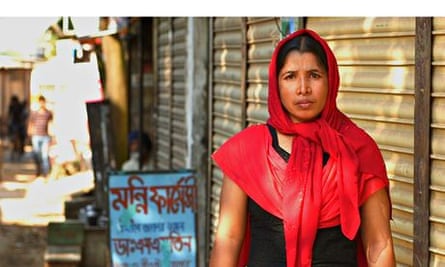
Of 20 women Shapla supervised in the building, 19 died. Photograph: David Levene for the Guardian
And what of the garment industry\\\’s role in all of this? Along with remittances from workers overseas, the industry is the only major foreign currency earner for the country. Wages for workers have risen since the disaster – the minimum monthly salary for an entry-level worker is now 5,300BDT (about £40) a month – but so have rents, and no one can pretend a family can live on a single salary. Factory conditions might have improved in the last decade, but even without the 1,130 who died in Rana Plaza, the toll from fires and other accidents would be intolerable. Along with the 4 million directly employed by the industry, economists say there are another 4 million people whose livelihoods depend on the internal demand it generates. If half of these 8 million people support a family of five, then around a sixth of the population depends on people several thousands miles away buying cheap clothes that they don\\\’t need.
And that means this world of ambiguity is one the consumer inhabits, too. Many debate where the blame lies for tragedies such as Rana Plaza, and argue over who has the responsibility to prevent them in the future. The owners of the factories? Those who let the buildings that house the workshops? The crooked builders? The bent bureaucrats? The government? The intermediaries who do so much of the buying? The brands?
Some western brands implicitly accept a degree of moral responsibility, even if their lawyers are careful to make sure their legal liability is strictly limited. “People portray companies as evil by definition, and in many aspects they are. But often times a company is forced to behave in certain ways by consumer behaviour. If no one buys your product, you are out of business. Consumers take decisions for companies, but often [they] don\\\’t, which means they don\\\’t care,” says one senior executive at a big European high street brand.
Though there is little statistical evidence of any direct correlation between bad publicity about social issues and sales – it would, experts say, be almost impossible to establish such a link anyway – big companies do their own research to understand the impact on sales of events such as the Rana Plaza collapse.
“Companies do very precise work on this to understand the consumers and what level of quality they are willing to pay for, and [it shows that] a large number of consumers prefer inexpensive over respect for human rights or environment,” the executive says. “After all, if you buy a pair of jeans at $9.99, what are you really expecting about the working conditions of those who made them or even just the environment in which they live?”
Mahmuda eventually found her husband\\\’s body, intact but for a broken nose, laid out in the makeshift morgue set up in the grounds of a local school. It took some days for her to realise that her husband was not going to walk through the door of their small home in Savar. She returned to her village to bury him, but life was as hard there as it had ever been and she was soon back in Savar. Eight months later, Mahmuda started work at another garment factory, less than 300m from where the Rana Plaza complex stood. She passes the site of the collapse – the rubble scraped away, a trough of filthy water, scattered bolts of filthy cloth, a stench of decayed matter – every day. “I tell myself if one building has collapsed, it doesn\\\’t mean they all will,” she says. “I can\\\’t be scared. If I am scared, how will I feed my family? I tell myself if one building has collapsed, it doesn\\\’t mean they all will.”
Runarini, however, has still not fully understood that her daughter will not come home. Shamapati\\\’s remains have never been found. It is possible that the 18-year-old\\\’s corpse may have been buried with 250 others, all unidentified, in the chaotic aftermath of the collapse. There is even a chance that, unrecognisable and untested, it may have been given to the wrong family. Bangladesh\\\’s only DNA testing facility was unable to cope with so many dead, and officials admit mistakes were made.
Preity still dreams of her village and misses her friends and school. Now she hopes to set up a tailoring shop when she is older, with help from an NGO. “My mum cries all the time,” she says. She misses her sister, too, and Shonjit, who sometimes walked her back from the factory. He was killed, too.
When Shonjit\\\’s father, Satyadip, who still works as a loader in a nearby factory, heard of the collapse, he ran to the site. “I was crazy. I tried to tear away the stones with my hands. For 13 days I went there, round all the hospitals, to find him, to find my son. I held on to my hope, but then we found him and he was not with us any more.”
Rubana Huq, managing director of the Mohammadi Group, travelled to the site of the collapse when she heard what had happened, though she has no link to the factories there. She set up a small relief operation and spent days handing out water and food to rescue workers. “It made me think differently about the workers; that it is another life, like mine,” she says.
Shapla has seen only one of the 20 girls she watched over since the day of the tragedy. She saw her, fleetingly, at a bus stop. She has heard news of a second. The rest she believes are dead. Now, when she sees their children, she feels “like a criminal”. “I was the one who got them to go in. I was the one they followed. I think about it all the time.”
Shapla has found a job at another factory but, due to her back injuries, as a sewing-machine operator, not a supervisor. She would prefer to do “any other job”, but the only alternative is manual labour on construction sites, building new factories and homes for workers, and she needs 10,000BDT (£75) to get her son into a local school.
Most of the victims have received money – some from the government, some from industry bodies, some from one or two brands, such as Primark, that have unilaterally decided to make payments while most other brands, the government, global unions and industry bodies argue over the level of compensation they will eventually pay out.
Every evening, Mahmuda, Satyadip, Shapla and approximately 4 million others in and around Dhaka stop work, exchange a few words with their colleagues and head home. They go out on to the broken, crowded streets, a stream of workers that flows together, then divides again round the stalls, the beggars, the lines of overloaded trucks, the packed buses immobile amid the rickshaws. They are joined by streams from other factories, flowing together before splitting again into smaller streams down the narrow lanes between the tenements, until these, too, eventually divide and divide once more, and it becomes dark, and the workers are home.
We Are What We Wear: Unravelling Fast Fashion And The Collapse Of Rana Plaza by Lucy Siegle and Jason Burke is published by Guardian Shorts (ebook, £1.99/$2.99). Visit guardianshorts.com to read an extract and buy your copy. The Shirts On Our Backs, an interactive documentary about Rana Plaza and the textile industry, is on theguardian.com/rana.