
Scathing new report warns that high energy prices are increasingly the ‘number one issue leading to factory closures and job losses’

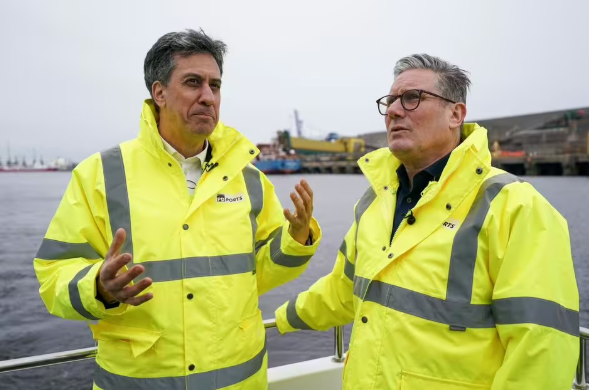
Ed Miliband and Sir Keir Starmer have ambitions to make the UK a green superpower (Image: Getty)
Britain stands on “the precipice of industrial collapse” because of surging energy costs that have been pushed higher by net zero policies, according to a new report from the Prosperity Institute. It warns: “Our energy-intensive industries, from steelmaking to ceramics, from poultry processing to industrial gases, are at just 50% of their annual output in 2000.
“The industry has gone from over 800,000 jobs to under 413,500, despite Britain’s population increasing by nearly 11million in this time.” The report – Destroying the Foundations: How Net Zero Could Wreck British Industry for Good – claims high energy prices are “increasingly becoming the number one issue leading to factory closures and job losses”. Author Rian Chad Whitton insists a “thriving industrial sector is essential for British prosperity”.
The report has been welcomed by Richard Tice, the deputy leader of Reform UK.
Writing in the introduction, he states: “Net zero is the greatest act of financial negligence ever imposed upon the British economy by Westminster. We cannot be a rich nation without cheap energy.”
He blames the push for net zero for “subsidising unreliable and unprofitable green energy, whilst punitively taxing and restricting fossil fuels and neglecting nuclear development”.
Warning of the threat to production sectors such as concrete, glass, steel, petrochemicals, and fertilisers, he warned: “Without these products, other industries such as farming, manufacturing, and construction would collapse, spelling local and national economic ruin. Whichever industries managed to survive would see astronomical price rises due to reliance on imports.
“We would have gone from the cradle of the Industrial Revolution to a client state dependent on others for our most basic materials, all because we dressed up economic stupidity as ecological virtue.”
The report warns: “We are entering a far more turbulent period than we have enjoyed for over 50 years, and we must have a strong industrial base.”

Reform UK deputy leader Richard Tice calls net zero the ‘greatest act of financial negligence’ (Image: PA)
Its publication coincides with research from the National Energy System Operator suggesting the drive to make the UK net zero by 2050 could cost the country £350billion more than a slower approach.
A Downing Street spokesman said protecting future generations “fundamentally reduces our exposure to fossil fuel markets which have caused half of all recessions since the 1970s”.