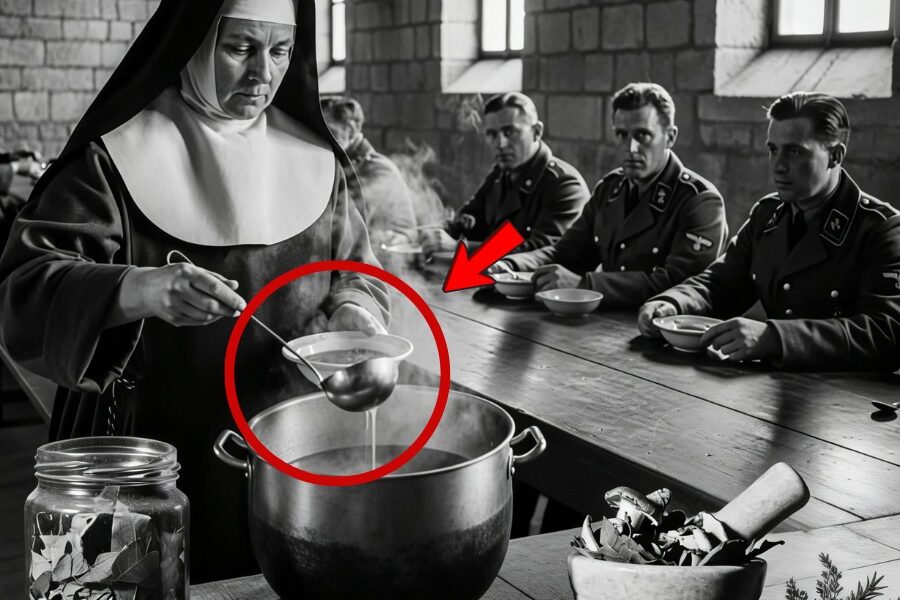

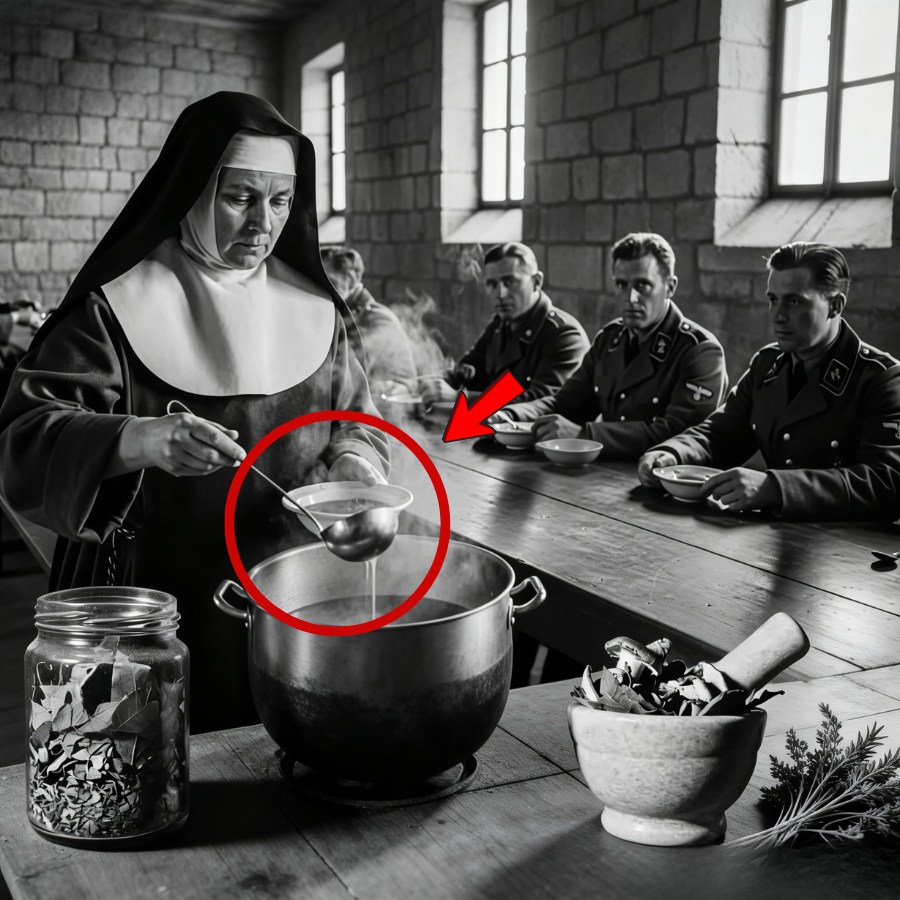
The scent of incense and damp stone mingled with the stench of diesel as German trucks drove through the gates of the Santa María de las Huelgas monastery. It was dawn on June 12, 1944, and Sister Teresa Vargas, kneeling in the chapel, felt the ground tremble beneath her weary bones.
She was 52 years old, her hands marked by decades of peeling potatoes, and she had no reason to go on living except for the rage that burned inside her like coal that never goes out. If you believe stories like this deserve to be told, subscribe now. The engines died. Silence.
Then, the sharp thud of military boots against the cloister stone. Teresa rose slowly, adjusting her black habit, and walked toward the kitchen with steps that no longer trembled as before. Six years had passed since the Gestapo lined up her brother, her sister-in-law, and her three nephews against the wall of an alley in Burgos, six years since she had heard, hidden in a nearby cellar, the sharp gunshots, one after another like firecrackers at a fair.
Six years since she stopped praying. Sisters, the shout came from the central German courtyard, poorly pronounced in Spanish. Everyone to the refectory. Now the Mother Superior, Elena de la Cruz, a petite woman with hawk-like eyes, walked at the head of the procession of 11 nuns who lived in the convent.
Teresa was at the back, her head down as always, like the invisible fat woman, the one no one looked at. Twice when they entered the refectory, the SS commander was already seated in the bishop’s chair. He was tall, blond, with a scar across his left eyebrow like a razor cut.
His uniform smelled of wet wool and tobacco. Behind him, 20 SS soldiers stood in a perfect line. Rifles slung over their shoulders, their eyes as blank as wax figures. “I am Strombanfer,” Klaus Reinhard said in mechanical Spanish, as if reciting from a manual, “this monastery is now an operations post for the Third Reich. You will continue your religious activities, but you will serve us food three times a day.”
Punctual, silent, obedient. The Mother Superior bowed her head. Teresa clenched her fists under the sleeves of her habit. “Who cooks here?” Reinhard scanned the row of nuns with predatory eyes. “I do, sir.” Teresa stepped forward. Her voice was hoarse, worn by years of enforced silence.
Reinhard looked her up and down. Then he let out a short, dry, humorless laugh. “You, perfect. A fat old hag who probably eats half of what she cooks.” He turned to his men. “At least we won’t starve if she survives, right?” Laughter erupted like shattering glass. Teresa didn’t blink.
Years ago, she had learned to build walls around herself, where words bounced off and fell dead. “You start tomorrow at dawn,” Reinhard continued. Soup, bread, meat, if there is any, no poison. Eh, another laugh, though I doubt a nun even knows what that is. That night Teresa didn’t sleep. She sat on the edge of her cot, staring out the narrow window at the dark mountains that bordered the French frontier.
The full moon illuminated the pine trees like silver skeletons. From that convent, the French Resistance had smuggled dozens of refugees—Jews, downed Allied pilots, children hidden in hay wagons. Now the SS slept 30 meters from the crypts, where false identities and escape route maps were kept.
At dawn, Teresa lit the wood-burning stove in the refectory kitchen. The fire crackled hungrily; she sliced onions with mechanical precision. The knife bounced on the oak board with a rhythm she knew by heart. She boiled water in the largest black iron pot, which held 50 servings.
She added potatoes, carrots, and a bit of bacon that the Mother Superior had kept since March. The aroma spread through the convent like a silent prayer. At 7 o’clock, the SS soldiers entered the refectory dragging chairs, laughing, talking in German about French women, about the Eastern Front, about how boring it was to guard a damned convent in the middle of nowhere.
Teresa served the soup in silence. The soldiers ate without looking at her. To them, she was a piece of furniture, an apron with legs. “More bread, fatty!” one shouted from the back table. The others laughed. Teresa brought more bread. Her hands didn’t tremble. That afternoon, when the SS went out to patrol the area around the monastery, Teresa walked toward the back garden.
There, among the rows of tomatoes and lettuce, something else was growing: Dalera, Digitalis purpurea, purple flowers on tall stems, beautiful and deadly. Decades ago, her mother had taught her that a single, improperly prepared leaf could stop a human heart in less than an hour, but in small, controlled, prolonged doses, it could mimic an illness: fever, vomiting, progressive weakness, the symptoms of a thousand things: dysentery, typhus, exhaustion.
Teresa tore out three pages and put them in the secret pocket of her habit. During the following days, she observed. The Germans trusted her, ate without question, emptied their plates to the bottom, mopped up the last drops of broth with bread, and never once suspected anything. Why would they? They were nuns, holy women, incapable of violence, incapable of hatred.
Teresa overheard conversations in German that she didn’t fully understand, but she caught names: Normandy, landing, retreat. The Nazis were losing ground. They needed this outpost to control the border, to intercept those fleeing toward Spain. On the night of the seventh day, Teresa ground the foxglove leaves into a fine powder.
He kept it in a small glass jar, about the size of a thimble, hidden at the bottom of a flour sack. The next day, while making soup, he added a pinch, so tiny it didn’t even change the broth’s color. He stirred slowly in perfect circles, silently praying not to God, but to the memory of his brother, his nephews, all those who had died with their hands raised and eyes filled with fear.
The soldiers ate, laughed, and complained about the heat. None dropped dead, none vomited. Perfect. That night, the Mother Superior entered the kitchen and found Teresa cleaning the iron pot with a damp cloth. “Sister Teresa,” Elena whispered. “The Germans trust you. That’s dangerous.” Teresa looked up.
Her eyes, small and sunken in a tired face, shone with something the Mother Superior hadn’t seen in years. “They trust all of us, Mother, because they believe nuns don’t lie.” Elena de la Cruz remained motionless. Teresa held her gaze without blinking. “What have you done?” the Mother Superior asked in a barely audible voice.
Teresa scrubbed the pot again. “I’m just cooking, Mother, as always, as I was ordered.” But at the back of the refectory, on the table where Sturmban Fürer Reinhard had sat that morning, lay an empty plate with remnants of soup stuck to the rim, and in the commander’s stomach, invisible as a snake’s venom, the first molecules of digitalis were beginning their slow, silent, irreversible work.
The first sign came three days later, when the youngest soldier in the battalion, a fair-eyed boy who couldn’t have been more than 19, vomited on his tray during breakfast. The other SS men laughed, thinking he’d drunk too much schnapps the night before. But Teresa, from the kitchen doorway, saw the boy clutching his stomach with trembling hands, his skin turning grayish in the morning light.
They dragged him out. She stirred the pot of porridge again expressionlessly, as if she hadn’t seen anything. Two days later, four more soldiers reported fevers. The battalion doctor, a thin man with round glasses and a barbaric accent, examined the sick in the makeshift infirmary they had set up in the south wing of the convent.
Dysentery, he diagnosed; contaminated water, most likely. He ordered everything to be boiled. He forbade drinking from the well in the courtyard. The SS began bringing bottled water from the nearest village, 15 km away. Teresa heard everything from the hallway as she scrubbed the stone floor with a stiff brush.
The doctor never mentioned the food. Why would he? The nuns ate the same thing. She herself ate the soup every day, sitting alone at the kitchen table, in silence. What the doctor didn’t know was that Teresa prepared two pots every morning. A large black iron one for the soldiers, a small copper one for the sisters—identical in appearance, different in contents.
The foxglove powder went into the large pot alone, and only Teresa served from it, always with the same hands, always with the same wooden spoon, marked with a small notch in the handle that no one else would ever notice. The weeks dragged on like snails on glass. Summer settled over the monastery with a stifling heat that made the ancient stones sweat moisture.
SS soldiers patrolled the surrounding area daily, checking roads, interrogating peasants, searching for fugitives they never found, because the French Resistance had temporarily suspended all operations in the region. Too dangerous, too many Germans. But inside the convent, something was beginning to rot.
Sturmban Fürer Reinhard lost weight. His uniforms, always immaculate, now hung slightly loosely on his shoulders. At night, he coughed a dry, rasping sound that echoed through the stone corridors. During breakfast on Friday, Teresa saw him refuse the bread, push his plate aside, and drink only black coffee.
His hands trembled as he held the cup. “What’s happening to us?” he growled at his second-in-command, a brutal sergeant named Hoffman, whose face seemed carved from granite. “Half my men are sick as dogs. It’s the water, the weather.” “What?” Hoffman shrugged. “The doctor says it’s dysentery, sir, common in these rural areas, lack of hygiene.”
The Spaniards made a dismissive gesture with their hands. Teresa walked past them with an invisible milk jug, as always. Reinhar didn’t even look at her. To him, she was part of the furniture, a fat shadow in a black habit who brought food and disappeared. But that night, when Teresa returned to her cell after praying the rosary with the other sisters in the chapel, she found something that stopped her in her tracks.
On her cot, neatly folded, lay a white handkerchief with embroidery at the corners—a child’s handkerchief. And in the center, stained with dried earth, was a drawing of a house, a sun, a stick figure family—the kind of drawings six-year-olds make. Teresa recognized the handkerchief. It had belonged to her youngest nephew, Miguel.
She had it in her pocket the day the Gestapo executed him in Burgos. Someone had entered his cell. Someone knew who she was, someone was sending her a message. Teresa’s hands trembled for the first time in weeks. She grabbed the handkerchief, pressed it to her chest, and felt something cold run down her spine.
Who? Who had left it there? She looked down the dark hallway; absolute silence. The other sisters were in their cells, sleeping or praying. The convent was steeped in that thick stillness that only exists in places of ancient stone, where even the lightest footsteps echo like drums. She sat on the edge of the cot with the handkerchief in her hands, and for the first time in six years, Teresa Vargas felt fear.
The next day, while lunch was being prepared, the Mother Superior entered the kitchen. Elena de la Cruz closed the door behind her with a soft but firm click. Sister Teresa said in a voice that brooked no argument, “I need you to tell me the truth. What are you doing?” Teresa continued cutting carrots.
The knife tapped the board with a mechanical rhythm. Tap, tap, tap. I’m cooking, Mother, as always. The Germans are dying. The Germans are sick. The doctor said so. Dysentery. Elena came closer. Her face, normally serene like that of a saint carved in wood, was tense, marked by lines of worry Teresa had never seen before.
“Eight men have died in two weeks,” the Mother Superior whispered. “Eight. The commander is as thin as a skeleton. Twenty others have fevers that won’t break. And you, you’re still cooking as if nothing’s wrong, as if you were innocent.” Teresa laid her knife on the board, wiped her hands on her apron, and finally met Elena’s gaze.
Do you want me to stop? The silence that followed was so thick that Teresa could hear her own heartbeat. Elena de la Cruz, woman of God, superior of 11 nuns, protector of fugitives, keeper of secrets, remained motionless like a pillar of salt. “I don’t know,” she finally admitted, her voice breaking. “God forgive me, but I don’t know.”
“Then let me continue,” Teresa said, picking up the knife again, “because I do know, I know exactly what I’m doing and I know why.” Elena took a step back, as if Teresa had transformed into something dangerous, something she didn’t recognize. “How many more are going to die?” “All of them,” Teresa answered without hesitation, without blinking.
Everyone who sits down to eat in that refectory, everyone who laughed when they called me a fat, useless thing, everyone who wears that uniform, everyone. The Mother Superior crossed herself. Her lips moved in silent prayer. Then, without saying anything else, she left the kitchen. Teresa heard her footsteps receding down the stone corridor.
The chapel door opened and closed. Elena had gone to pray, to ask God for guidance, or perhaps to ask forgiveness for her complicit silence. That afternoon, Teresa climbed the mountains surrounding the convent. She carried a wicker basket and a small knife hidden beneath her habit. She walked for an hour until she reached a clearing where mushrooms grew in the shade of the oak trees. Not just any mushrooms.
The death cap, or Manita phalloides, is beautiful, with smooth, olive-green caps. Innocent in appearance, it is deadly if consumed. A single mushroom could destroy an adult man’s liver in 48 hours. Two or three, mixed with other ingredients, accelerated the process. The symptoms were identical to those of a severe gastrointestinal illness.
Vomiting, diarrhea, organ failure, death. Teresa cut 12 mushrooms with surgical precision and placed them in the basket. She covered them with dry leaves. As she descended the mountain, the sun sinking behind the peaks like a broken egg yolk, she sensed a presence behind her.
He stopped and turned his head. At the edge of the road, half-hidden among the trees, stood a man. He wasn’t wearing a German uniform. He wore peasant clothes: thick wool trousers, a faded shirt, and a black beret. He was a thin, middle-aged man with several days’ growth of beard and eyes that shone with sharp intelligence.
“Sister Teresa,” he said in perfect Spanish with a barely perceptible French accent, “don’t shout, don’t run, just listen.” Teresa clutched the basket to her chest. “Who are you?” “Someone who knows what she’s doing,” the man replied, taking a step forward, “and someone who needs me to stop.” “I’m not going to stop.”
If you continue, the Germans will find you. And when they do, they won’t just kill you, they’ll kill all the nuns in the convent, burn the building down, and execute all the peasants in the nearby villages in retaliation. Understand that. Teresa stared at him. You’re part of the resistance. The man didn’t answer directly, “What I’m doing here is none of your business.”
This is what matters. We have a plan to evacuate the fugitives hiding in the crypt. But we need two more weeks. Two weeks without incident, without suspicious deaths, without the Germans putting the convent under total surveillance. If you keep killing them, you’ll ruin everything. You understand, Teresa said, her voice like stones clinking. “They killed my family.”
They killed my nephews, children, shot them against a wall like dogs. I know. The man nodded. And I’m sorry, but there are 17 people hiding in that convent right now. Jews, British pilots, orphaned children. If the Germans find them, they’ll all die. Those 17 lives are worth their revenge. Teresa closed her eyes.
The mountain wind lashed at her face, cold and sharp. In her mind, she saw the face of Miguel, her nephew, smiling as he held that white handkerchief with embroidered corners. She saw her tall, strong brother carrying his children on his shoulders. She saw her sister-in-law, eight months pregnant, with her hands raised, crying out for mercy that never came.
Then he saw the faces of the 17 fugitives hiding in the bowels of the convent. Faces he had never seen before, but knew were there. Faces that depended on silence, on invisibility, on patience. He opened his eyes. Two weeks, he said. Then I’ll continue. The resistance fighter nodded slowly.
Two weeks. And if she’s still alive by then, do what you have to do. But now, hide those mushrooms and for God’s sake, be more careful. She disappeared among the trees as quickly as she had appeared. Teresa was left alone on the path with the basket of poisonous mushrooms in her hands and the weight of 17 lives on her shoulders.
When he returned to the convent it was almost night. The bells were ringing vespers. He stored the mushrooms in the cellar, under a pile of flour sacks in a corner where no one ever looked. Then he went up to the chapel, knelt on the last pew, and pretended to pray. But he wasn’t praying; he was counting.
Fourteen days, 336 hours, 1660 minutes. And when that time was up, Teresa Vargas was going to finish what she had started. That night, Sturmban Futer Reinhard collapsed in his room. The doctor found him lying on the floor, convulsing with foam at his lips, an erratic pulse, and an uncontrolled body temperature. They stabilized him, but as soon as Hoffman temporarily took charge, Teresa prepared dinner in the kitchen with steady hands—no poison, no mushrooms, no foxglove for now—but deep in her heart, where hatred burned like
Eternal coal, Teresa knew this wasn’t over. It was just a pause, a respite, a countdown. And when the two weeks were up, the SS would discover that the useless old fat woman was actually the most dangerous thing that had ever entered their lives. The two weeks slipped by like sand through closed fingers.
Teresa counted every day, every hour, every meal served without poison. The SS soldiers began to recover slowly. Stormban Führer Reinhard was able to walk again, though thinner, paler, with deep dark circles under his eyes that made him look like a walking corpse. The doctor attributed the improvement to the change in water, the hygiene measures, and luck.
She never suspected the food, never looked at the fat old nun who silently served the soup. During those 14 days, Teresa watched as the French Resistance moved the fugitives. They did it at night in carts covered with hay, disguised as peasants, nuns, merchants. One by one, the 17 faces hidden in the crypt disappeared into freedom.
Teresa never saw them. She only heard hurried footsteps in the darkness, whispers in French, the creaking of the floorboards under the weight of fleeing bodies. On the last night of the truce, the Mother Superior entered Teresa’s cell. She didn’t knock; she simply walked in, closed the door behind her, and stood in the dim light, illuminated only by the candle Teresa kept burning beside her cot.
“They’re all gone,” Elena de la Cruz said. “All 17 are safe.” Teresa nodded without looking up from the rosary she held in her hands. “And now,” the Mother Superior asked, “are you going to continue?” “Yes.” “Then may God have mercy on your soul, because I can no longer save you.” Elena left.
The door closed with a soft click. Teresa blew out the candle and sat in the darkness, listening to the silence of the convent, the wind rattling the windows, the beating of her own heart. At dawn, she went down to the cellar. She retrieved the phalloid mushrooms she had hidden under the sacks of flour. Some were dry, others still retained some moisture.
She cleaned them carefully, removed the dirt, and cut them into small, almost microscopic pieces. She mixed them with the foxglove powder that still remained in the glass jar. The combination was lethal, irreversible, and fast-acting. That morning, while preparing breakfast, Teresa poured the mixture into the large pot of oatmeal.
She stirred slowly, watching as the poison dissolved into the thick, invisible, undetectable liquid. The aroma of oatmeal with cinnamon and honey filled the kitchen—sweet, innocent, deadly. At 7 o’clock sharp, SS soldiers entered the refectory. Forty-three men had arrived as reinforcements the previous week from the French border, replacing those who had died or been transferred.
New faces, clean uniforms, young men laughing and talking about Spanish girls, about the cheap village wine, about how boring it was to be stationed at a convent lost in the mountains. Teresa served the porridge bowl after bowl. The soldiers ate ravenously, mopped up their plates with bread, and asked for more.
She served expressionlessly, avoiding eye contact as always, like the fat, invisible shadow she had been for six years. Two hours later, it began. The first soldier vomited in the middle of the courtyard during the morning drill. He doubled over, clutching his stomach, shouting German words Teresa didn’t understand, but whose meaning was clear.
Pain, unbearable pain. Three more fell to the ground soon after. Convulsions, foam at the mouth, eyes rolled back. The medic rushed from the infirmary with his black bag, shouting orders. But it was too late. By noon, 12 soldiers were dead. Their bodies lay in a row in the central courtyard, covered with gray tarpaulins, while the rest of the battalion watched with expressions of horror and disbelief.
Stormban Futurer Reinhard, who hadn’t eaten breakfast that morning because he still felt unwell in his stomach, ordered the convent closed. No one in, no one out. Immediate interrogations. Hoffman and six other soldiers began searching every room, every corner, every closet.
Teresa was in the kitchen cleaning the oatmeal pot when she heard boots approaching. She put the rag down on the table and turned around just as Hoffman walked in with two more soldiers, rifles in hand. “You!” the sergeant growled, pointing his finger at her. “What did you give them to eat this morning?” “Oatmeal with cinnamon and honey, as usual.”
Where did you get the oats? From the sack in the basement, the same one we’ve been using for weeks. Hoffman narrowed his eyes at her. He was a brutal man, but not stupid. He had survived four years of war on the Eastern Front. He knew the smell of betrayal. Show it to me now. Teresa went down to the basement, followed by the three armed men.
The air there was cold, damp, and smelled of earth and moo. The stone walls sweated moisture. Hoffman examined the sack of oats with expert hands, reached inside, pulled out a handful of grains, smelled them, and tasted them with the tip of his tongue. “It’s clean,” he murmured. “What else did you use, Cinnamon?” Honey, water from the new well you yourselves approved.
And the other ingredients, where are they? Teresa pointed to the shelves. Hoffman checked every jar, every bag, every box. He found flour, salt, sugar, dried spices. Nothing suspicious, nothing out of place. But then one of the younger soldiers, a red-haired boy with freckles, crouched down by the sacks at the back. He nudged one with his foot.
Something rolled. Sergeant said, pointing at the ground. Hoffman approached. There, in the dark corner where Teresa had hidden the mushrooms, was a small piece of death cap, barely the size of a coin, olive green, unmistakable to anyone who knew the plants of the region. Hoffman picked it up, holding it between his fingers as if it were a diamond.
Then he looked at Teresa with a slow, terrible, humorless smile. “Oronja verde,” he said in perfect Spanish. “My grandfather taught me about these when I was a child. They grew in the Bavarian forests, beautiful, deadly.” He crushed the piece of mushroom between his fingers, letting the remains fall to the ground. “Do you know what happens when someone eats this, nun?” Teresa didn’t answer.
“They rot from the inside out,” Hoffman continued. “Their livers disintegrate, their kidneys fail, they vomit blood, they scream for hours before they die. And you,” he took a step toward her. “You’ve been poisoning us.” “No,” Teresa said firmly. “I just cook.” The slap came so fast Teresa didn’t have time to dodge it.
Her head snapped violently to the side. She tasted blood in her mouth. Hoffman grabbed her habit and dragged her upstairs to the central courtyard, where the rest of the battalion waited beside the covered corpses. Stormban Führer Reinhard stood by the stone fountain, pale as a ghost, trembling with barely contained rage.
“Is it her?” he asked hoarsely. “Yes, sir,” Hoffman replied, pushing Teresa to the ground. “We found poisonous mushrooms hidden in the cellar. She mixed them into the food.” Reinhard walked slowly toward Teresa, stopped in front of her, and looked down at her as if she were an insect crushed under his boot.
“Why?” he asked. “Why did you do it?” Teresa spat blood on the floor and looked up. “Because you killed my family, my nephews, children aged 6, 8, and 10. You lined them up against a wall in Burgos and shot them like animals. So yes, I poisoned them, and I would do it a thousand times over.”
The silence that followed was absolute. Even the wind seemed to stop. The SS soldiers stared at Teresa with expressions that wavered between horror and respect. Reinhar stood motionless, processing the words, and then slowly began to laugh. A dry, bitter laugh, devoid of joy. A vengeful nun, he said. What an irony.
She turned to Hoffman. “Gather all the sisters in the courtyard. Now, sir, now.” Ten minutes later, the convent’s eleven nuns stood in a line before the bodies of the German soldiers. Mother Superior Elena de la Cruz was visibly trembling. The younger sisters wept silently.
Teresa was kneeling in the center of the courtyard, her hands tied behind her back, blood trickling from her mouth. Reinhard walked slowly past the nuns, examining them one by one. “One of you,” he said, “is a murderer, a poisoner. She killed 12 of my men this morning. She probably killed the other 20 who died in the last few weeks.”
She stopped in front of the Mother Superior, and I’m sure she didn’t act alone. Someone helped her, someone covered for her. So I’m going to give you a chance. Tell me who else knew, tell me who helped her, and maybe, just maybe, I’ll execute the guilty one. Elena de la Cruz closed her eyes. Her lips moved in silent prayer.
The other sisters remained silent, petrified with fear. “No one,” the Mother Superior finally said, her voice barely audible. No one knew. Only her. Reinhard stared at her for a long moment. Then he nodded slowly. Very well, then you will all see what happens when someone betrays the third Rich.
He drew his Luger from its holster. The metal gleamed in the July sun. He turned to Teresa, aimed, and at that moment, the distant sound of explosions came from the mountains. One, two, three. The ground trembled slightly. The SS soldiers stared at the horizon with alarmed expressions. “Sir!” shouted a soldier from the watchtower.
Partisans, they’re blowing up the bridges on the northern route. Reinhard lowered his weapon. His face contorted in a mask of absolute fury. The French Resistance had taken advantage of the chaos at the convent to attack, and now, with half his battalion dead or incapacitated, the outpost was vulnerable.
Hoffman ordered, “Take 20 men and secure those bridges. I’ll take care of this.” He looked at Teresa. “You, you devilish nun, you’re going to die slowly, very slowly, but first you’re going to see me burn this convent to the ground and every sister inside.” Teresa looked up. Her eyes, small and sunken in a bruised and bloodied face, shone with something Reinhard hadn’t expected to see.
It wasn’t fear, it was triumph, because Teresa had just understood something crucial. The fungus hadn’t just killed 12 soldiers that morning; it had weakened the entire battalion, and the resistance knew it. They had been waiting, watching, and now, with the Germans vulnerable, they were attacking.
She hadn’t just been a lone avenger; she’d been the first link in a much larger plan. And though she was going to die, though she was going to burn, though her name would be forgotten, she had done her duty. Reinhard saw that expression on her face and, for the first time in four years of war, felt something akin to fear. The fire began at nightfall.
The SS soldiers dragged wooden benches, tables, old books from the convent library—anything that would burn—and piled it in the center of the courtyard. The flames grew fast, ravenous, illuminating the ancient stones with an orange glow that seemed to have come from hell itself. Teresa was tied to a wooden post in front of the bonfire, her hands bleeding from the tight ropes, her face swollen from the blows, her black habit torn.
The 11 nuns of the convent knelt in a row, forced to look on with SS soldiers behind them, rifles pointed at the backs of their necks. Sturmban Führer Reinhard paced back and forth in front of Teresa, his Luger in hand, wiping the barrel with a white handkerchief. He had lost 28 men in the last few hours: 12 to poison that morning, and 16 more in attacks by the French Resistance that had erupted simultaneously at three different points in the region.
The bridges were blown up, supply routes cut, the convent outpost completely isolated. “Do you know what fascinates me about you, nun?” Reinhard said, stopping in front of Teresa. “It’s not that you poisoned us—that’s simple, predictable. What fascinates me is that you did it patiently, precisely, for weeks, like a soldier.”
He crouched down to be at eye level with her. “Who taught you? Who told you how to do it?” Teresa spat blood at his feet. “No one. I learned it on my own.” Reinhard laughed. A short, dry, humorless, lying laugh. “No one does this alone. The partisans used you, manipulated you, and now they’re leaving you to die alone while they escape like rats.”
She stood up. But it doesn’t matter, because you’re going to die knowing you failed. You’re going to die knowing this convent will be reduced to ashes and all your sisters—she pointed toward the kneeling nuns—will die with you. The Mother Superior raised her head. She knew nothing about us, Elena de la Cruz cried out, her voice trembling but not breaking.
The fugitives we were hiding, the escape routes, nothing. She acted alone out of personal revenge. We’re innocent. Hoffman, who had returned from the failed attack on the bridges, his face covered in soot and barely contained rage, approached Reinhard. “Sir, we need to retreat. The French are cutting off all the exits.”
In two hours we’ll be completely surrounded. Then let them surround us. Reinhard growled. But first this. He raised the Luger and pointed it directly at Teresa’s head. Any last words would be poisonous. Teresa stared at him. Her lips, cracked and bleeding, curled into something that almost resembled a smile. 50, she whispered. What? 50.
Matthew, 50 of you: the 12 from this morning, the 20 from previous weeks, and another 18 who died later, but who already had the poison in their systems. 50 SS soldiers, one useless old fat woman, 50 dead Nazis. He coughed up blood. That’s more than most of your officers killed in the entire war.
The silence that followed was so thick that Teresa could hear the crackling of the fire, the sisters’ ragged breathing, the irregular beating of her own shattered heart. Reinhar clenched his jaw. His knuckles turned white around the grip of the Luger. But before he could pull the trigger, a voice shouted from the watchtower.
Sir, movement on the northern perimeter, partisans, many distant explosions, gunfire, shouts in German. Chaos erupted in the convent like a sudden storm. SS soldiers rushed towards the walls, leaving the nuns alone in the courtyard. Hoffman shouted orders.
Reinhard gazed toward the mountains, where the flashes of explosions illuminated the night sky like colorful lightning. And at that moment, Teresa understood that the resistance wasn’t attacking to save her. They were attacking because she had fulfilled her part of the plan, weakened the battalion, made them vulnerable, and now the French partisans were finishing the job she had started in the kitchen with poisonous mushrooms and ground daffodils.
She wasn’t a victim being rescued; she was a weapon that had been fired, and weapons, once used, are discarded. Reinhard turned to face her. His face, illuminated by the flames, was a mask of absolute hatred. “This is your fault,” he hissed. “All this,” he pointed the Luger. “And you’re going to die without seeing whether they won or not.” He squeezed the trigger.
The shot echoed in the courtyard like thunder. Teresa felt the impact on her chest as if an iron hammer had struck her. The pain came afterward, sharp, unbearable, spreading throughout her body like liquid fire. She fell to her knees, still tied to the post, blood soaking her black habit.
Her vision blurred. She heard screams, explosions, more gunfire. The world became a chaotic jumble of muffled sounds and flickering lights. But before the darkness completely consumed her, Teresa saw something. A man at the edge of the yard, the same man who had stopped her on the mountain weeks before.
The French resistance fighter was crouched behind a stone column, rifle in hand, watching her. Their eyes met for a second, and the man did something Teresa didn’t expect. He nodded. A slow, almost reverent bow, a salute, an acknowledgment. Then he raised his rifle and fired.
Reinhard fell dead before he could fire again. Teresa closed her eyes. The pain vanished. The noise faded, and in the darkness she saw her brother, her nephews, smiling, waiting for her. It was over. Fifteen days later, the Santa María de las Huelgas monastery was liberated by the combined forces of the French Resistance and the clandestine Spanish Republican troops.
The Germans had abandoned the post after losing more than 40 men in the coordinated attacks. The nuns survived. The convent remained standing, though riddled with bullets and fire. Teresa Vargas’s body was found in the central courtyard, tied to a burnt post with a bullet hole in her chest.
She was buried in the convent cemetery, in an unmarked grave, beneath a cypress tree that had grown crooked from the mountain winds. Mother Superior Elena de la Cruz wrote a detailed report about what had happened, about how Teresa had systematically poisoned 50 SS soldiers over seven weeks, about her sacrifice, her revenge, and her death. That report was never published.
September 1944, Paris liberated. The leaders of the French Resistance met in a requisitioned building in the city center. Among them was the man who had spoken with Teresa on the mountain. His real name was Jeanclaude Morrow, commander of a clandestine cell operating on the Spanish border.
He had Mother Superior Elena’s report on his desk. He read it twice, then put it in a sealed envelope and filed it away in a classified file. “We can’t make this public,” he told his colleagues. A nun poisoning German soldiers, a woman of God killing with premeditation. It’s complicated, problematic.
It’s not the kind of heroism we need to promote right now. But she killed 50 men. Another member protested. Alone, with poisonous plants. She deserves recognition, and she will get it, Moró replied. But not like this. We’ll say it was a sabotage operation coordinated by partisan cells. We’ll say we infiltrated the German outpost and poisoned their supplies.
No names, no details, just another victory for the resistance. She closed the file. It’s better this way for her, for us, for history. And so it was done. 1945, end of the war. Official reports of the liberation of northern Spain briefly mentioned the successful sabotage operation at the Santa María de las Huelgas monastery, where French partisans neutralized an entire SS battalion by poisoning their supplies.
No names were mentioned, no medals were awarded, there was no public recognition. Mother Superior Elena de la Cruz tried to rectify the situation. She wrote letters to newspapers, to Allied commanders, to Spanish authorities. No one responded. Or worse, she was told to drop the matter, that it wasn’t prudent, that a murderous nun, however justified her reasons, wasn’t the kind of story people needed to hear after so much death and destruction.
Elena died in 1952, frustrated knowing that the truth about Teresa Vargas had been buried as deeply as her nameless body. 1998, German National Archives, Berlin. A Spanish historian named Dror Manuel Ortega was investigating declassified Gestapo documents when he found something extraordinary.
A report dated August 1944, written by the doctor of the SS battalion stationed at the Santa María de las Huelgas monastery, had been filed away as a minor poisoning incident and remained forgotten for 54 years. The report was clinical, precise, and devastating. Postmortem analysis of 50 soldiers who died between June and August 1944 revealed systematic poisoning with Digitalis purpurea and Amanita foides.
Source identified: Sister Teresa Vargas, convent cook, executed on August 14. Conclusion: A single individual, without military training or identifiable logistical support, eliminated more SS personnel than any operational resistance cell in the region during the same period.
Recommendation: Review food safety protocols at all forward operating bases. Dr. Ortega read the document three times. His hands trembled. He searched for more information. He found the Mother Superior’s buried report in church archives. He found birth records, documents from the Spanish Civil War, and testimonies from local farmers who remembered the fat nun who cooked for the Germans.
She published her research in 1999 in a book titled Forgotten Heroes: The Invisible Women of the Resistance. The chapter on Teresa Vargas was 50 pages long and included photographs of the convent, copies of the German report, and testimonies from the sisters who were still alive. The book was a bestseller in Spain and was translated into French, German, and English.
Teresa Vargas, the old, fat nun who had been ridiculed, humiliated, and forgotten, was finally recognized for what she truly was: one of the deadliest guerrillas of World War II. A woman who transformed her kitchen into a battlefield, a silent avenger who killed 50 Nazis with poisonous plants and infinite patience, and a heroine whose name had been erased because her story was too uncomfortable, too dark, too real for the sanitized, heroic narrative the world wanted to believe after the war.
2024 Monastery of Santa María de las Huelgas. Today, in the convent cemetery, beneath the cypress tree twisted by the wind, there is a new gravestone. It was placed in 2003, paid for by French resistance veterans who read Dr. Ortega’s book and decided it was time to do justice. The inscription reads, “Sister Teresa Vargas, 1892–1944, not with swords, but with soup.”
She killed 50 soldiers. SS, never forgotten, finally remembered. Tourists visiting the convent often pass by that grave without a second glance. It’s small, unassuming, easy to miss, just as Teresa was in life. But those who know the story stop. Some leave flowers, others bottles of Spanish wine, and a few, those who truly understand the meaning of the inscription, leave small jars of spices: cinnamon, dried herbs, silent tributes to a woman who transformed the most innocent ingredients into weapons of war. Because
The truth, however uncomfortable, finally came to light. Teresa Vargas was not a saint, not a perfect martyr; she was a woman broken by loss, consumed by rage, who decided that if she was going to die, she would take as many of her enemies with her as possible. And she did so with patience, with intelligence, with a determination so cold and calculated that even the Nazis who executed her remembered her with a mixture of horror and respect.
History forgot her for 54 years, but stories like hers don’t stay buried forever. Eventually, the truth emerges—it always does—sometimes late, sometimes when no one from that era is still alive to tell the tale, but it emerges, and when it does, it forces the world to remember that heroes aren’t always young, strong, attractive, or convenient.
Sometimes they’re old, fat, invisible. Women who serve soup with calloused hands and eyes that hold storms. Women like Teresa Vargas, who cooked revenge for seven weeks and died knowing she had won. Bitom. If this story touched you, subscribe and stay with us. There are still many hidden truths the world needs to know.
Stories of people erased by power, forgotten by history, who deserve to be remembered, because the truth, however painful, always deserves to be told. M.