Black GIs Humiliated By US MPs in Canada. But The Canadians Said “NOT HERE!” _us

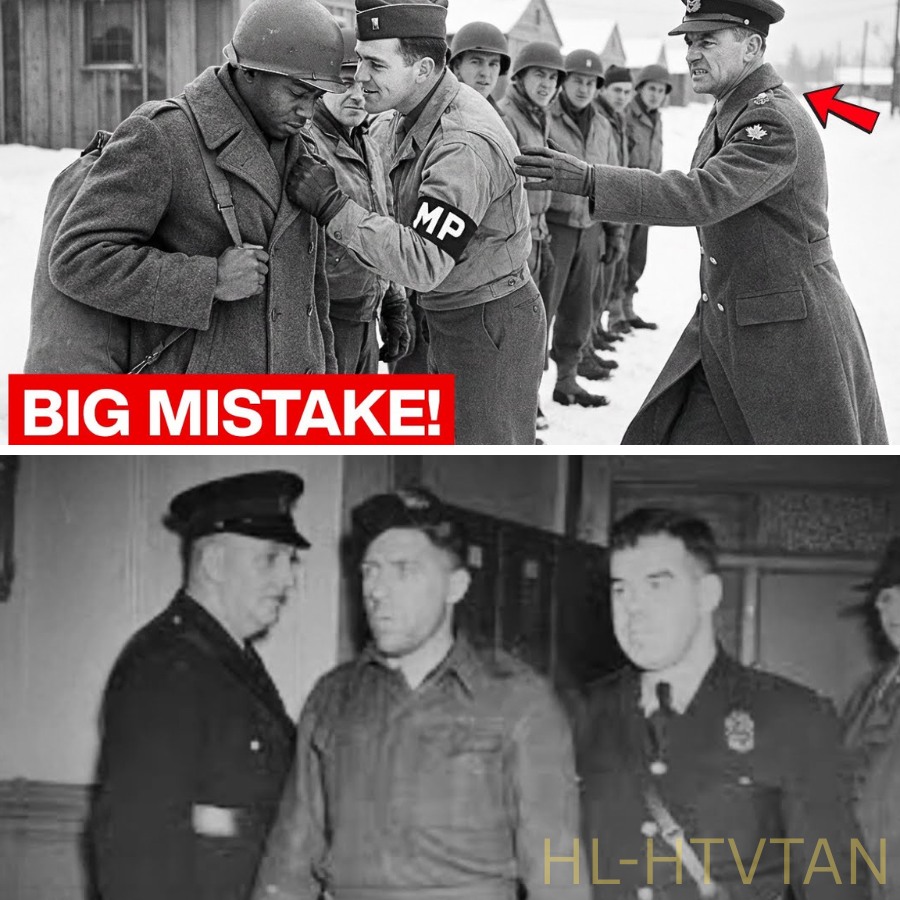
The first punch wasn’t a fist.
It was a sentence—sharp, familiar, and carried like a club.
“You boys need to move along.”
It landed on the sidewalk outside the Carlton Hotel like a command issued in a place that belonged to someone else. The words came from a white American military police sergeant with a face already flushed by heat and anger, the kind of man who looked like he’d been raised on rules so old he couldn’t imagine a world without them.
It was July, 1942, and Halifax was thick with summer. The air held the smell of salt from the harbor just a few blocks away, mixed with diesel and warm asphalt. Street lamps had just flickered on, casting a yellow glaze across Hollis Street. Inside the hotel, waiters were setting tables, silverware glinting beneath chandeliers.
Outside, three Black American soldiers stood near the entrance in the same green uniforms as every other GI in town. They hadn’t come looking for trouble. They hadn’t come to make a statement. They weren’t drunk or loud or reckless.
They were hungry.
Private James Thompson, twenty-two, from Chicago, shifted his weight and tried to keep his voice respectful. “Sir,” he said, confused, “we just want to eat. We have money.”
The sergeant didn’t care. He leaned closer, his breath smelling like cigarettes and coffee. “This section is whites only.”
There were no signs saying that. Not on the hotel, not on the street, not in Halifax. But the sergeant said it like it was a law carved into the pavement.
Thompson hesitated—just long enough for the sergeant to decide hesitation was defiance. A thick hand shot out and grabbed Thompson’s sleeve. The pull was hard. Not guiding. Not firm. A yank meant to remind.
Thompson stumbled backward. His shoulder hit a lamp post with a dull, metallic thud. Pain flashed across his face. The second MP grabbed the other soldier, fingers digging into cloth as if the uniform were a leash.
Thompson’s cap slipped sideways. His mouth opened, a protest rising. But years of habit pressed down on his tongue. He had learned what happened when Black men protested in front of white police.
Even when the police wore a uniform that was supposedly fighting for freedom.
A few Canadians walking by slowed. Then stopped. At first it was curiosity—the way people turn their heads at raised voices in the evening. But the moment they saw a white MP’s hands on a Black soldier, curiosity hardened into something else.
A woman in a blue dress stepped forward. She looked like she’d just come off a factory shift—tired shoulders, purse clutched tight, hair pinned back with the discipline of someone who couldn’t afford fuss. Her name was Eleanor Macdonald, and she didn’t pause to consider diplomacy.
Her voice cut through the warm air like a knife.
“You’re not in Mississippi now, Yank!”
The sidewalk went still for a heartbeat. The MP’s head snapped toward her. His eyes narrowed, offended that a civilian—worse, a Canadian woman—had spoken to him like that. The second MP’s hand tightened on the soldier’s arm. Thompson blinked, stunned, not by the insult but by the fact that someone had said it out loud.
And in that moment—one street, one hotel, one bleeding nose—the tension Halifax had been carrying all summer finally cracked open.
Because this wasn’t the first time Americans had tried to bring their rules into Canada.
It was just the first time a crowd had decided to answer.
Not here.
Not on our streets.
Not in our country.
But to understand how the city reached that moment, you have to understand what Halifax was in 1942, and what the Americans dragged into it like mud on their boots.
By the summer of that year, the world was burning. Hitler’s armies held Europe in a fist. Japanese forces ruled the Pacific. Every week, German U-boats prowled the Atlantic hunting the convoys that carried food and weapons to Britain. Halifax Harbor never slept. Ships gathered there like nervous animals, waiting for the moment they’d be sent into the ocean’s teeth.
Canada sat at the center of this fight, and Nova Scotia felt it in its bones. More than 15,000 American troops were stationed across Canada, especially in Nova Scotia and Newfoundland. They came to guard docks, move cargo, repair equipment, protect the flow of ships that kept Britain alive. The Americans brought money. Jazz spilled from dance halls. Chewing gum appeared in children’s hands like magic. Hollywood confidence rode in on every uniformed smile.
They also brought something else.
They brought Jim Crow.
Back home, segregation wasn’t just custom—it was law and violence and a thousand tiny humiliations stitched into daily life. Black Americans couldn’t eat in the same restaurants as white Americans. Couldn’t sit where they wanted on buses. Couldn’t drink from the same fountains. The United States military mirrored the same divisions. Black soldiers served in separate units, slept in separate barracks, ate in separate mess halls. Even blood was segregated in military hospitals, as if racism could reach into veins and rewrite biology.
Over a million Black Americans would serve during the war. Most would not see combat. They loaded cargo ships. Dug ditches. Built roads. Cooked food. Washed dishes. They did the work that kept the war machine alive, while being told—officially—that they were naturally suited for labor, not for leadership.
Canada wasn’t perfect. Halifax wasn’t paradise. Black Canadians faced prejudice—landlords who refused to rent, employers who refused to hire, quiet hate that didn’t need a sign to exist. But Canada had no Jim Crow laws. No official “whites only” signs. A Black person could walk into a restaurant and sit down. They could ride a streetcar anywhere. They could buy a ticket to any seat in a cinema. The law didn’t mandate separation.
So when Black American soldiers arrived in Halifax, something strange happened.
For many of them, Canada felt like stepping into a world their own country had promised but never delivered.
Private William Jones from Mississippi could sit at a lunch counter beside white Canadian workers and not get dragged outside. Corporal Robert Williams from Alabama could ride the streetcar without being shoved to the back. Sergeant Thomas Jackson from Georgia could walk down Hollis Street without calculating every glance as a possible threat.
Some of them tasted a kind of dignity they’d never known. They were young—twenty, twenty-five—and suddenly a shopkeeper called them “sir.” A waitress smiled without flinching. A theater clerk sold them a ticket like their money was just money.
It was small. Ordinary. Exactly the point.
And the white American military police saw it as chaos.
In their minds, discipline meant segregation. Order meant keeping Black soldiers “in their place.” They watched Black GIs eat beside white civilians and decided Canada needed correction.
So they started doing what they had always done: enforcing rules through pressure and force.
It began with small incidents that were easy to ignore if you wanted to keep the peace with a powerful ally.
In May 1942, two Black soldiers walked into the Capitol Theater on Barrington Street to see a film. They bought tickets, found seats in the middle section, and settled in. Halfway through the movie, two white MPs marched down the aisle, boots thumping on the carpet. They shone flashlights into the soldiers’ faces.
“Out,” one MP said. “This theater is segregated now.”
The soldiers stared, confused. They’d been here the week before with no trouble. The Canadian ticket seller had smiled and taken their money. Nothing had changed except these MPs standing over them.
“Sir,” one soldier said quietly, “we paid for our tickets.”
“I don’t care what you paid,” the MP replied. “Out.”
The theater manager—a thin Canadian man with anxious eyes—hurried over, trying to explain that his theater had no separate sections. All seats cost the same. All customers were welcome.
The MPs didn’t listen.
They grabbed the soldiers by the arms and dragged them up the aisle while the audience watched in shocked silence. The soldiers didn’t fight back. They knew what happened to Black men who fought white police, even in places where the law didn’t demand it.
June brought worse.
MPs began visiting dance halls before weekend socials. They told owners to create “white nights,” to turn away Black soldiers at the door. The Starlight Ballroom on Spring Garden Road received one of these visits on a Tuesday afternoon. Three MPs walked in while staff mopped floors.
“Saturday nights are for white servicemen,” the sergeant told the owner, Mrs. Patricia Murphy. “You’ll turn away colored soldiers at the door.”
Mrs. Murphy had run that dance hall for fifteen years. She was small, gray-haired, and had the kind of voice that could slice through a crowded room when she needed it.
“I’ll do no such thing,” she said.
The sergeant leaned closer. “Then you’ll lose white soldiers’ business. All of it. We’ll make sure they go somewhere else.”
Mrs. Murphy’s hands shook, but she didn’t step back. “Then I suppose I’ll lose their business,” she said.
The MPs left, but the threat stayed in the air like smoke.
Then it moved to the beaches.
Chocolate Lake, just outside Halifax, had a small beach where soldiers went swimming on hot days. One Saturday, eight Black soldiers arrived with towels and swimming trunks, having walked miles from their barracks.
Two MPs waited at the entrance like gatekeepers.
“This beach is closed to colored troops,” one said.
“Since when?” a soldier asked.
“Since now.”
The Black soldiers could see white GIs laughing in the water fifty yards away, sunlight glinting off the surface. The heat was brutal. They had been looking forward to this all week.
They turned around and walked back, because what choice did they have? Fighting would mean the stockade—or worse.
Canadians who lived near the beach saw it happen. They told neighbors. The story spread. Conversations sharpened in grocery lines, churches, shipyard breakrooms. Some Canadians shrugged and said it was American business. But more felt anger twist in their stomachs.
These men wore Allied uniforms.
How could their own people treat them like dirt?
July came like a storm already gathering.
Incidents grew frequent. A Black soldier turned away from a lunch counter. Another refused service at a barber shop. Two removed from a park bench. MPs appeared at doors like men policing the boundaries of someone else’s country.
Canadian police watched from sidewalks and corners, uncertain. American MPs were foreign military on Canadian soil. Did Canadian law apply? Could a Halifax officer arrest an American MP? Nobody seemed sure, so most did nothing.
That uncertainty was part of why the MPs grew bolder.
And that boldness is what brought them to the Carlton Hotel on the hot evening of July 6.
Outside the hotel, the confrontation with Thompson and his friends unfolded exactly like it had in the South: hands on arms, voices mean, the assumption of automatic obedience. It might have ended quietly too—another humiliation swallowed by men trained to survive.
Except Eleanor Macdonald’s voice cut through the air.
“You’re not in Mississippi now, Yank!”
And suddenly, the sidewalk became a circle of witnesses.
Canadians who had been trying not to see began to see.
Five people became ten. Ten became twenty. Twenty became thirty. People coming home from work stopped when they heard shouting. They saw the MPs shoving Black soldiers. They saw Thompson’s bloody nose. They didn’t like what they were seeing.
The hotel manager, Robert Chen, heard the commotion from inside. He pushed through the front door and stepped onto the street.
“What’s going on?” he demanded.
Sergeant Patterson—the big Alabama MP—turned toward him. “Just maintaining order, sir. These colored boys need to understand. This establishment is whites only.”
Chen’s face flushed red. “I decide who comes into my hotel,” he snapped. “Not you.”
The air tightened.
“My establishment serves all Allied servicemen,” Chen continued, voice rising. “If you don’t like it, don’t come here.”
It was a simple sentence. But in that moment, it was a declaration.
A Canadian business owner had just told American MPs they did not get to bring segregation into his doorway.
Patterson’s hand moved toward his club. The crowd pressed closer. There were too many people now, too many eyes, too much risk of turning this into an international incident on a street corner.
He looked around, calculating. He grabbed his partner’s arm.
“This isn’t over,” Patterson muttered.
Then he shoved through the crowd and left.
The moment didn’t end with fists.
It ended with something more powerful: Canadians refusing to step aside.
Chen helped Thompson up and guided him inside, his voice gentler now. “Come on,” he said. “I’ll get you cleaned up. Then you’ll eat.”
That night, Chen wrote letters. He sent copies to the mayor, to newspapers, and to American command. He stated plainly that his hotel would not segregate. Any soldier in Allied uniform could eat in his dining room.
Within days, other business owners followed.
Mrs. Murphy at the Starlight Ballroom posted a sign in her window: All Allied forces welcome. No exceptions.
The Capitol Theater manager instructed ticket sellers to seat anyone anywhere. When MPs came to complain, he asked them politely to leave.
The rebellion was spreading.
But rebellion is never tidy. It doesn’t stay contained. And the next night, the city learned just how quickly resistance could turn into confrontation.
On July 7, the Starlight Ballroom was packed.
The band played swing music that made the wooden floor vibrate. Perfume mixed with sweat. Soldiers danced with Canadian women under spinning lights. About two hundred people filled the hall.
Among them was Corporal David Wilson, a Black soldier from the 88th Engineer Battalion. He was twenty-three and had never been to a real dance back home in Georgia. In the South, a Black man dancing with a white woman could get him killed.
In Halifax, a red-haired Canadian woman named Mary Sullivan asked him to dance.
They laughed. They moved with the music. For a few minutes, the war felt far away.
Then the MPs walked in.
Three of them.
And Sergeant Patterson was leading again.
He didn’t scan the room. He didn’t hesitate. He walked straight across the dance floor like a man who believed the room should part for him.
He grabbed Wilson by the shoulder and yanked him away from Mary.
“You’re under arrest,” Patterson said.
“For what?” Wilson asked, voice shaking now.
“Fraternizing,” Patterson snapped. “Causing a disturbance.”
Mary stepped forward, furious despite her small frame. “He wasn’t causing anything,” she snapped. “We were just dancing.”
“Stay out of this, miss,” Patterson barked.
The music stopped.
The room went silent.
The kind of silence that happens when people realize they’re about to choose a side.
The MPs grabbed Wilson’s arms and started dragging him toward the door.
And that was when Canadians moved.
A man in work clothes stepped into their path. “Let him go,” he said.
“This is military business,” Patterson snarled.
“This is our dance hall,” the man replied, voice steady. “In our city. In our country.”
More Canadians stepped forward. They formed a human wall. Ten people, twenty, thirty. Arms linked. Bodies pressed together. The MPs tried to push through, but the crowd didn’t move.
The MPs dragged Wilson outside toward their vehicle parked nearby.
The crowd followed.
More than fifty Canadians poured out of the dance hall and surrounded the MP car—front, back, sides. Patterson couldn’t drive away without running people over.
For ten long minutes, nobody moved. The MPs stood by the car. The Canadians stood around it. Wilson stood in the middle, breathing hard, heart pounding so loud he could hear it inside his skull.
Then Halifax police arrived.
Two Canadian officers walked up, faces unreadable. Everyone held their breath.
Would the Canadian police clear the crowd? Would they assist the MPs?
The senior Canadian officer looked at Patterson. Then at Wilson. Then at the crowd.
“What seems to be the problem?” he asked.
Patterson explained he was arresting Wilson for fraternizing.
The Canadian officer listened, then shook his head.
“That’s not against Canadian law,” he said plainly. “I can’t help you arrest someone who hasn’t broken our laws.”
Patterson’s face turned purple. “This is military jurisdiction!”
“Not on our streets, it isn’t,” the officer replied. “Let the soldier go.”
The crowd erupted in cheers. Patterson had no choice. He released Wilson and got into his vehicle.
The Canadians parted just enough to let the car through. As it drove away, people clapped and shouted. Some hugged Wilson. Mary took his hand.
And the words that had been shouted outside the Carlton Hotel now echoed louder, carried by fifty voices instead of one:
Not here.
By Sunday morning, Halifax buzzed with the story. The mayor—Alan Butler—called a press conference. He stood on City Hall steps and declared Canadian businesses would not segregate on orders from foreign military police. Halifax welcomed all Allied servicemen. The city would not participate in policies that contradicted Canadian values.
Behind closed doors, Nova Scotia’s premier, Angus Macdonald, contacted Ottawa. Federal officials were warned: American MPs were overstepping. If the incidents continued, it would become a diplomatic crisis.
Canadian liaison officers met with American commanders and delivered a simple message: Canadian law did not recognize segregation. Canadian civilians would not enforce it. If American MPs continued, there would be consequences—not from fists, but from politics.
American command was stuck.
They couldn’t enforce Jim Crow without Canadian help, and Canadian help was not coming.
So they tried a middle path—unofficial segregation zones, suggested recreation areas, attempts to herd white soldiers and Black soldiers into separate social spaces.
Canadians ignored those suggestions.
Black soldiers kept going to the Carlton Hotel, the Starlight Ballroom, the Capitol Theater. Canadian civilians kept welcoming them.
And something else happened: the city began actively showing Black soldiers they were wanted.
Canadian women organized socials specifically inviting Black GIs, renting church halls, hiring bands, sending invitations directly to segregated units. Some families invited soldiers to Sunday dinners. Roast beef, potatoes, pie—ordinary meals that carried extraordinary dignity.
For men raised under Jim Crow, it was like discovering oxygen.
Private Thompson returned to the Carlton Hotel the following Saturday. He sat at the bar and ordered a beer. The bartender served him with a smile. White and Black soldiers sat nearby. Nobody told him to leave.
He drank slowly, savoring not just the taste but the simple feeling of being treated like any other customer.
For one year, in one place, ordinary people refused to participate in injustice.
But resistance has costs. Halifax wasn’t paradise. Not every Canadian welcomed Black soldiers. Some businesses quietly refused service. Some landlords wouldn’t rent rooms. Canadian women who dated Black soldiers faced ugly comments and cold stares. Rocks appeared through windows. Notes with hateful words were slipped under doors.
And the Americans—especially white troops from the deep South—did not always accept what Halifax offered.
Fights broke out. Sometimes on base. Sometimes in alleys between town and barracks. A white soldier would make a comment. A Black soldier would respond. Fists would fly. Bottles would shatter. Sometimes knives came out.
One August night, three white soldiers jumped a Black private named Robert Hayes on his walk back to base. They beat him badly, breaking ribs and blackening eyes. Canadian police found him unconscious in an alley. The attackers were caught and punished, but the lesson was bitter: hatred doesn’t evaporate just because a city refuses to enforce it.
Still, something fundamental had shifted.
Within a week of the Starlight Ballroom incident, Sergeant Patterson disappeared from Halifax streets. No official announcement. He was simply gone—quietly reassigned somewhere less inconvenient, somewhere where crowds didn’t surround police cars and tell them “no.”
American command issued new orders, carefully worded, never admitting wrongdoing, but clear enough: MPs should focus on actual crimes, not on who sat where in restaurants or who danced with whom. It wasn’t worth the trouble.
Inside American bases, segregation remained.
But outside, in Halifax streets, the walls came down.
And that mattered.
Because it meant tens of thousands of Black American servicemen—eventually more than 30,000 passing through Canadian deployments by war’s end—experienced something dangerous:
They learned segregation wasn’t natural law.
It was a choice.
They learned dignity could be ordinary.
They learned “whites only” wasn’t inevitable.
Some carried that memory back home like a secret weapon.
Private James Thompson returned to Mississippi in 1945. On the train ride south, he watched the signs change: whites only water fountains, colored waiting rooms, the familiar architecture of humiliation reappearing like a nightmare.
He tried to live quietly—work at a mill, marriage, children.
But he never forgot Canada. He never forgot eating at the same table. He never forgot being called “sir” without sarcasm.
When the civil rights movement surged in Mississippi years later, Thompson joined NAACP work. He marched. He helped register voters. Crosses burned in yards. Bullets shattered windows.
When people asked why he risked so much, he talked about Halifax.
“I lived it,” he would say. “I saw it. The world didn’t end when we ate together. So I know Jim Crow is a lie.”
And the ripple didn’t stop there.
In Halifax, Black Canadians watched those incidents too. A woman named Viola Desmond, who ran a beauty school and salon, saw the contrast—Canadians welcoming Black American soldiers while those soldiers were still beaten by their own military police. It sharpened something inside her about discrimination at home. In 1946, she refused to move to the balcony of a Nova Scotia theater and was arrested under the absurd charge of tax evasion—a case that later became a Canadian civil rights landmark.
The hypocrisy was glaring: Canadians who’d defended Black American soldiers’ dignity now had to confront their own unofficial segregation.
History rarely moves in straight lines. It moves in echoes.
There were other echoes too—officers like Captain John Roosevelt Robinson, a Black American officer assigned to liaison work, who lived in two worlds: segregated mess halls on base, dinner invitations from white Canadian officers off base. His diary captured the daily contradictions, and later he used that lived evidence in civil rights testimony.
There were teachers like Margaret McLeod, who organized dances and helped veterans immigrate to Canada after the war. At least fifteen Black American veterans settled permanently in Halifax with help from people like her. Some married Canadian women and opened businesses that served everyone—no exceptions.
Even enemies noticed. German POWs in Canadian camps wrote confused letters home describing Black American guards treated with more courtesy by Canadians than by their own officers. The contradiction undermined everything Nazi propaganda claimed about racial hierarchies.
And propaganda did try to exploit America’s hypocrisy. Nazi broadcasts and Japanese radio pointed to segregation as proof America didn’t fight for freedom, only for its own power. Halifax’s refusal to enforce Jim Crow became, in a small way, a counter-image: not all Allies supported the American racial code.
The Halifax story doesn’t have a neat ending. Racism didn’t disappear in Canada. Segregation didn’t vanish overnight in America. Many veterans who tasted dignity in Halifax returned to danger and humiliation at home.
But the story matters because of what it shows about power.
Segregation wasn’t sustained only by laws. It was sustained by people willing to enforce it—by hands on arms, by clubs at doorways, by crowds who looked away.
And when those crowds stopped looking away—when they linked arms, when they told an MP “not on our streets,” when a Canadian police officer refused to help arrest a man for dancing—segregation weakened.
Not everywhere.
Not permanently.
But enough to prove something vital:
Ordinary people have leverage.
Not the kind you buy.
The kind you choose.
Decades later, when the Carlton Hotel was gone—torn down, replaced by an office building—Halifax installed a small plaque near where it once stood, acknowledging the moment when civilians resisted imported segregation and chose dignity.
Most people walk past plaques without noticing.
But plaques aren’t built for people rushing by.
They’re built for memory.
Because memory is how choices outlive the moment.
And the choice Halifax made in the summer of 1942 was simple, and therefore explosive:
When a powerful ally tried to drag injustice across the border like luggage, the city didn’t pretend it was polite.
It didn’t shrug and say “not our business.”
It didn’t fold just because the men carrying the clubs wore the same uniform as the men fighting Hitler.
It looked at the injustice, and enough people said, in enough voices, loud enough to matter:
Not here.
Not in our city.
Not in our country.
Those words didn’t end racism. They didn’t rewrite the war. They didn’t purify anyone’s history.
But they created a space—real, physical space—where a Black soldier could sit at a bar, order a beer, and be treated like a man.
And for people who had never been allowed that simple dignity, the memory became dangerous.
Because once you’ve lived in freedom—even briefly—you never forget what it feels like.
And you never stop wanting it for everyone.