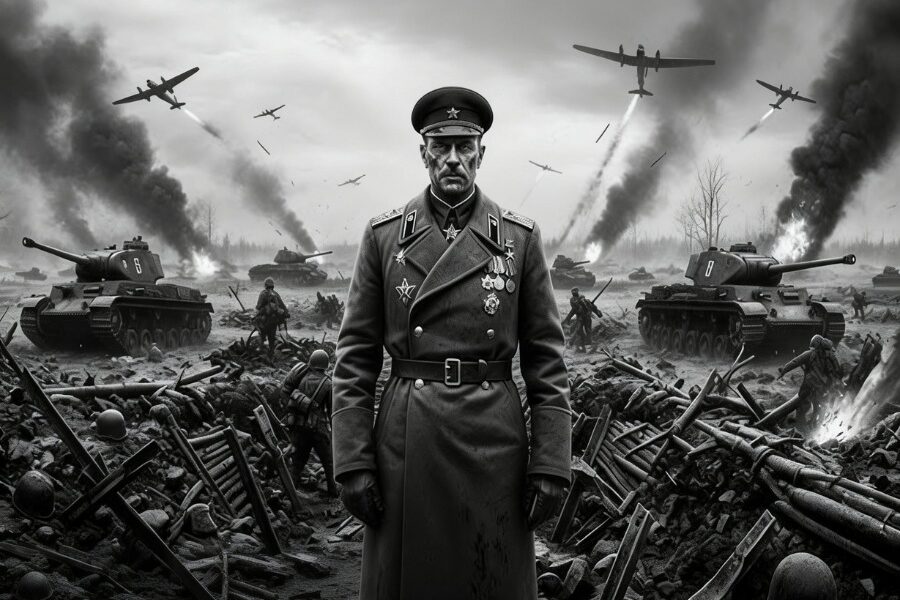

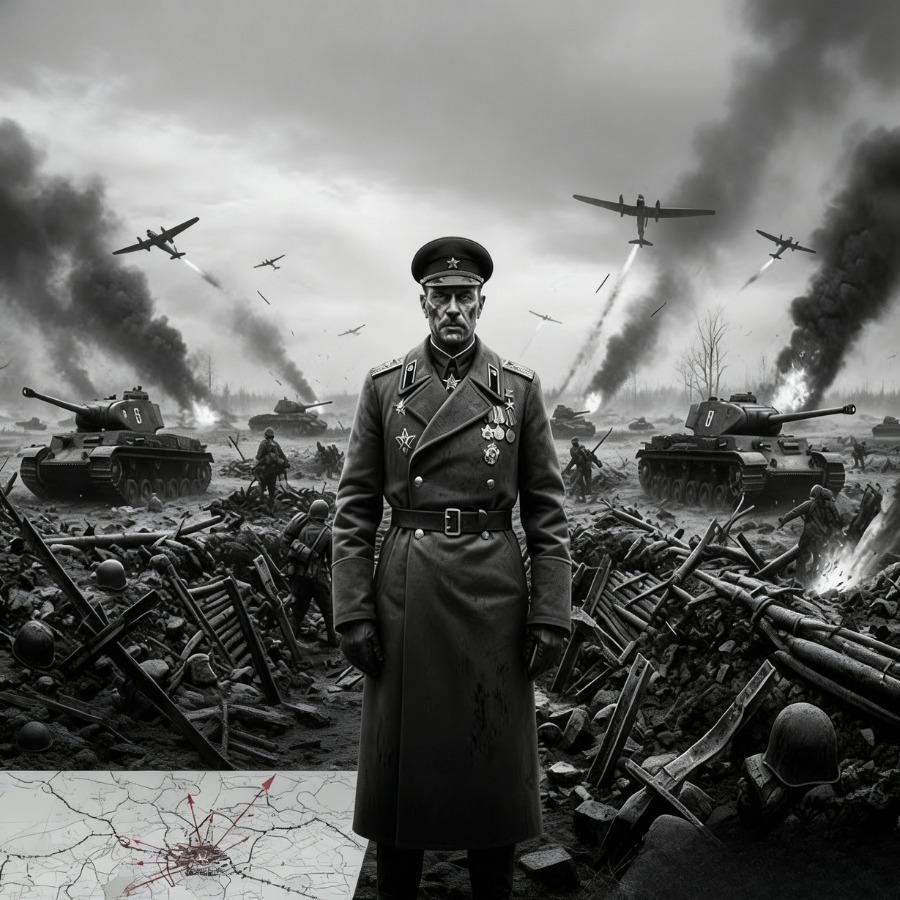
December 1941. A German soldier shiveres inside a frozen trench 30 km from Moscow. His fingers are black with frostbite. His frost-covered rifle won’t fire, and the body of his comrade beside him has turned to stone. He can see the Kremlin’s golden domes gleaming in the full moon, so close he swears he could touch them if he reached out.
Victory is just one step away, but then he hears something that makes his blood run cold. Silence. An unnatural silence that devours even the wind. For six months, the Vermacht has been a steel storm, sweeping everything in its path. Poland fell in 27 days. France surrendered in six weeks. The Soviet Union was to be the next victim, just one more obstacle before total domination.
The Panzer divisions devoured 1,000 km of Soviet territory like fire on dry paper. Nothing could stop them. Nothing until now. Because at that moment, while the German soldier gazes at Moscow with empty eyes, a million Soviet soldiers emerge from the darkness like ghosts from the snow. They are not the terrified peasants they faced in July.
They are Siberian warriors trained for the white hell, equipped to survive, where Germans can only die. And at the head of this lethal onslaught is a man whose name will make Berlin tremble. Ge Shukov. The ground begins to tremble beneath the German soldier’s feet. First softly, like a distant heartbeat, then violently, as if the earth itself were waking in fury.
Thousands of T-34 tanks roar through the snow as Soviet artillery turns night into day with a thousand fiery bursts. Shouts in German mingle with explosions. Chaos replaces order. Terror devours arrogance. The Soviet Union is about to learn a brutal lesson that will change the course of World War II.
The perfect plan can become the perfect trap. And Chukov just pulled it off. This is the story of how one man turned the 20th century’s deadliest military doctrine against its own creators. It’s not a tale of invincible heroes or impossible battles won by sheer luck. It’s the bloody chronicle of how brutal intelligence can transform imminent defeat into devastating victory.
It is the story of how Gorgukov studied the Vermacht with the patience of a hunter. He identified the fatal crack in its perfect armor and exploited it with calculated violence that would make German generals tremble from Moscow to Berlin. While German tanks could touch the Kremlin walls, while Hitler ordered preparations for the triumphal parade through the streets of Moscow, while the whole world considered the Soviet Union dead, a silent man watched the chessboard with eyes of steel. Chukov did not
He saw defeat, he saw opportunity, because he had understood something the arrogant Nazi strategists had never considered. The Blitzkrieg, that perfect machine of lightning warfare, had a deadly flaw hidden in its very design. And that flaw was about to cost Germany more than just a battle.
It would cost them the war. What you are about to witness is not Soviet propaganda or romanticized historical revisionism. These are brutal facts documented in the war archives of both sides. It is the testimony of frozen soldiers who watched the white hell devour their comrades. It is the confession of German generals who, for the first time in the war, tasted the bitter sting of panic.
It’s a bloody demonstration that military genius doesn’t need to invent new tactics when they can use the enemy’s weapons to tear them apart. Before continuing, if this story grabs you from the first second, if you want more unfiltered content of brutal warfare and military strategy, subscribe to this channel right now.
Like this video so more people can discover these world-changing stories. And leave a comment telling me what country and city you’re watching from. I want to know where the true military history buffs are. Are you ready to witness how Stalin’s silent butcher turned the Russian snow into the graveyard of the Vermacht? Because what follows is a precise dissection of how an invincible army is destroyed.
Word by word, move by move, death by death. June 22, 1941, at 3:15 a.m., 3 million German soldiers crossed the Soviet border in the largest land assault in human history. There was no declaration of war, no warning, only the deafening roar of 3,000 tanks tearing through the earth while the Luftwaffe darkened the sky with 2,000 aircraft.
Operation Barbarossa has just begun, and with it Adolf Hitler’s attempt to wipe the Soviet Union off the map in eight weeks. The first few days are an unprecedented bloodbath. The Panzer divisions advance 50 km a day, tearing through Soviet defenses like hot knives through butter.
Entire cities disappear beneath the steel tracks. Red Army soldiers, caught off guard in their barracks, are massacred before they can even load their rifles. In the first 72 hours, the Luftwaffe destroys 12 Soviet aircraft, most of them burned to a crisp on the ground before takeoff.
It is the Blitzkrieg, in its purest and most lethal form. The German doctrine is a masterpiece of coordinated violence. First, the stucas descend like metallic birds of prey, bombarding command centers and lines of communication until they are reduced to smoldering rubble. Then, the pancer divisions pierce the enemy front at specific points, penetrating deep like steel lances.
Motorized infantry immediately continued widening the gap while tanks pressed on relentlessly. Finally, the pincers closed around hundreds of thousands of Soviet soldiers trapped in encirclement pockets that became open-air slaughterhouses. In the Battle of Biawistok-Minsk, 300,000 Soviet soldiers were surrounded and annihilated in just 11 days.
In kyiv, 650,000 men fall into the German trap. These are numbers that defy human comprehension. Entire armies simply cease to exist. Stalin’s generals shout orders over radios that have already been destroyed. Soviet divisions evaporate under the relentless hammer of the Vermacht.
The world watches in horror as the Soviet Union bleeds to death. German generals are euphoric. Franz Halder, Chief of the General Staff, writes in his diary that the campaign is practically won. Heines Guderian, the master of the Panzer Divisions, reports that his tanks are advancing rapidly and that the main problem is keeping them fueled.
In the German officers’ mess halls, glasses are raised in toasts to the inevitable victory. Berlin is already plotting how to divide the Soviet Union’s corpse, but while the Nazis celebrate, something strange begins to happen. The Soviets do not surrender, even when surrounded. Even without ammunition, even without hope, they keep fighting.
They fight to the last bullet, and then they fight with bayonets. When the bayonets break, they fight with stones and their teeth. It is a fanatical resistance the Germans never saw in Poland or France. Every village becomes a fortress. Every forest hides partisans who slaughter German patrols in the dark. German supply lines begin to stretch dangerously.
The Panzer tanks are 300 km inside Soviet territory, but the trucks transporting fuel and ammunition must travel along primitive roads that turn into rivers of mud in the August rain. The tanks devour fuel faster than it can be delivered. Repairs pile up because spare parts take weeks to arrive from Germany.
September arrives with the first autumn rains. The Soviet mud, the dreaded rasputza, swallows entire truckloads. The Panzer divisions, which once flew across the steppes, now advance at a snail’s pace. The German soldiers, who had hoped to be home by Christmas, begin to look at the horizon with less certainty.
Something in the air has changed. The sweet scent of easy victory now mingles with something more bitter, somewhere behind the collapsing Soviet lines. A stony-faced man studies maps covered in red markings representing destroyed divisions. Weorgukov doesn’t celebrate, doesn’t shout, he just studies.
Because while the Germans gaze toward Moscow, dreaming of glory, he is calculating precisely how to turn that dream into their worst nightmare. The storm of steel has reached its peak. Now comes winter, and with it, vengeance. October 10, 1941. An armored train cuts through the darkness toward Moscow, carrying the man Stalin both fears and needs.
Horgi Constantinovic Shukov travels silently, chain-smoking as he studies blood-soaked intelligence reports. He has just saved Leningrad from the German siege with tactics so brutal that even the political commissars recoiled in horror. He had generals shot for cowardice.
He ordered every building to be defended until it became a tomb. He transformed the city into a slaughterhouse where every square meter cost 100 German lives. Now Stalin sends him to Moscow with a simple, impossible order: Stop the Vermacht or die trying. Shukov is not a military aristocrat educated at prestigious academies.
He is the son of peasants, raised in abject poverty, hardened by the civil war, where he learned that war is not an elegant chessboard, but a pit from which only the most ruthless survive. During Stalin’s purges, he saw his comrades shot for imagined treason. He survived because he was too competent to eliminate and too useful to ignore.
Stalin hates him because Shukov doesn’t fear him, but he respects him because Shukov wins battles when everyone else only produces corpses. The train arrives in Moscow as the city teeters on the brink of total collapse. The streets seethe with barely contained panic. Bureaucrats burn classified documents in bonfires that light up the night.
Factories are evacuating to the Urals in overcrowded trains where people travel hanging from the ceilings. Stalin has ordered all government buildings to be mined, prepared to blow up the Kremlin rather than surrender it. The General Staff is evacuating to Kuibev. Moscow is being left to its fate. Shukov arrives at the Kremlin covered in mud and ash.
Stalin receives him in his office, where the thick tobacco smoke barely masks the scent of fear. The dictator gets straight to the point with his slow, heavy voice that has doomed millions. “Comrade Shukov. The Germans are 30 kilometers away. My generals say Moscow will fall in a week. Tell me the truth. We can save the city.”
Chukov doesn’t hesitate, he doesn’t mince words. We can, but I need total authority. No political interference, no commissar questioning tactical orders, and I need you to bring me all the divisions from Siberia. All of them. Stalin watches him with those predatory yellow eyes. Then he nods slowly.
You have what you asked for, but if you fail, I’ll have you shot myself. Shukov leaves the Kremlin and goes straight to the front. What he finds there is a horror that would surpass the nightmares of any general. The Soviet divisions are shattered, reduced to bleeding skeletons barely holding their positions.
The soldiers fight with one rifle for every three men. The artillery fires its last shells. Burned-out tanks litter the landscape like steel tombstones. And on the other side, through binoculars, Chukov can see the black crosses of the Panzer tanks preparing for the final assault. But Chukov doesn’t see defeat. He sees a chessboard and begins to move the pieces with the cold precision of a surgeon amputating gangrenous limbs to save the body.
He orders the abandonment of strategic positions that only drain men without offering any real advantage. He withdraws shattered units rather than let them die needlessly. He concentrates the remaining artillery at specific points where it can inflict maximum damage and, above all, begins to accumulate reserves in absolute secrecy. The Siberian divisions begin to arrive on night trains.
These are fresh troops, hardened by the brutal climate of the Far East, equipped with winter coats and modern weaponry. Shukov hides them in forests east of Moscow, forbidding any daytime movement, any radio signals, anything that might betray their presence. The Germans cannot possibly know these units exist.
They must believe the Red Army is on the verge of total collapse. Meanwhile, Shukov studies his enemy with maniacal obsession. He reads every intelligence report on German movements. He personally interrogates captured prisoners of war. He analyzes attack patterns, bombing schedules, and supply routes. He maps the disposition of every pancer division, every infantry battalion, and every artillery battery.
He knows the names of the German commanders, their preferred tactics, their psychological weaknesses. He studies the Blitzkrieg like a biologist studies a deadly virus, searching for the exact point to insert the needle that will kill the organism, and he finds that point. The Vermacht is stretched to its limit, like a rubber band stretched to its fullest extent.
Their supply lines are fragile threads stretching hundreds of kilometers through hostile territory. Their tanks are mechanically exhausted. After five months of continuous combat, their soldiers wear summer uniforms as the temperature drops below zero. They are hungry, frozen, and worn out, but above all, they are arrogant, so confident of imminent victory that they have let their guard down.
November ends with the first snowflakes falling on Moscow. The Germans launch their final assault, convinced that one last onslaught will break the Soviet resistance. The Panzer tanks advance roaring through the snow while the Luftwaffe hammers the Russian defenses. Some German units get so close to Moscow that the soldiers can see the red stars of the Kremlin with binoculars.
Victory seems inevitable. Shukov observes the attack from his underground command post. He doesn’t smile, he doesn’t celebrate, he simply checks his watches and waits for the precise moment, because he knows something the Germans are about to discover in the most painful way possible. The hunter who pursues his prey too far into the dark forest eventually becomes the prey, and the trap is about to snap shut with steel teeth.
To understand how Chukov destroyed the Vermacht, you must first understand what made the Blitzkrieg so lethal. It wasn’t simply speed or firepower; it was a completely new military philosophy that revolutionized modern warfare. The Germans had learned from their mistakes in World War I, where millions died trapped in static trenches that didn’t move an inch after months of carnage.
“Never again,” German strategists vowed, “would the next war be one of movement, of speed, of psychological shock that would break the enemy before they could react.” Blitz Creek operated in phases synchronized with Swiss watch precision. Phase one: massive aerial bombardment that destroyed command centers, airfields, supply depots, and railway junctions.
The enemy is blinded, deafened, and paralyzed before the ground battle even begins. Phase two. The Pancer divisions attack in a wedge formation, concentrating overwhelming force at a narrow point in the enemy front. They do not attempt to destroy the entire opposing army; they simply pierce through, penetrate deeply, and advance relentlessly.
Phase three. Motorized infantry exploits the gap, widening it while tanks advance toward targets deep in the enemy’s rear. Phase four. The pincer movement closes, encircling entire armies in pockets of encirclement where they are systematically annihilated. This doctrine had worked with mechanical perfection in Poland, Denmark, Norway, the Netherlands, Belgium, France, Yugoslavia, and Greece.
Armies that were formidable on paper were crushed in weeks or even days. The German military seemed invincible because it had discovered the secret code of modern warfare. Speed, greater concentration of force, greater psychological shock, equals inevitable victory. It was pure military mathematics, but Chukov, studying this perfect machine from the shadows, identified the fatal flaw hidden in its brilliant design.
The Blitz Creek relied entirely on maintaining momentum. The tanks had to keep advancing forward, without pauses, without consolidation, without waiting for the infantry to catch up. That relentless speed was their greatest strength, but also their fatal weakness. Because an army that advances faster than its supply lines eventually runs out of fuel, ammunition, and food; it becomes a sword stuck deep in the enemy’s body, but severed from the hand that wields it. The Germans knew this.
Of course. Their tactical manuals specified maximum penetration distances before consolidating, but arrogance had blinded them. In France, they penetrated beyond all doctrinal limits and still won because the French collapsed psychologically. In Russia, they assumed the same would happen.
They advanced 300, 400, 500 kilometers into Soviet territory, stretching their supply lines like silken threads, on the verge of snapping, and they expected the Soviets to simply surrender to such a show of force. But Chukov wasn’t going to surrender. He was going to wait. Wait until those tanks, now roaring unstoppably, were so far from their supply bases that every liter of gasoline, every artillery shell, every crate of ammunition would have to travel hundreds of kilometers along destroyed roads.
Wait until the Russian winter transformed that logistical problem into an impossible nightmare. Wait until the German soldiers were so exhausted, so frozen, so desperate that their steely morale rusted until it shattered. While he waited, Shukov built his counterattack using the exact same German doctrine because he had understood something the Nazis, in their delusional racial supremacy, had never considered.
Blitz Creek wasn’t magic; it was military science that anyone could learn and apply: concentration of force, speed, surprise, encirclement. The principles were universal, and Shukov was about to prove that a dedicated student could overcome the arrogant master. He amassed his Siberian divisions in absolute silence.
120,000 fresh men equipped with winter coats, felt boots, and hot rations; T-34 tanks with diesel engines that functioned perfectly at 40 degrees under fire; KB1 artillery that could fire projectiles capable of penetrating any German tank; and above all, high morale. These men had not been defeated, humiliated, or massacred for months.
They arrived fresh at the slaughter, thirsting for German revenge. Shukov positioned them exactly where the Germans were weakest, not in the center, where the elite Pancer divisions maintained constant pressure on Moscow, but on the northern and southern flanks, where second-line German infantry units, frozen and exhausted, held positions with no nearby strategic reserves.
Those flanks were the precise point to insert the knife. Breaking through them would mean severing the supply lines of the advanced pancer divisions, isolating them, encircling them, destroying them. It was the reverse Blitzkrieg. The Germans had used this tactic to draw Soviet armies closer for months.
Now Shukov was going to use it to bring Hitler’s best Panzer divisions closer. The irony was delicious. The Vermacht would be destroyed by its own perfect doctrine, executed by the enemy they had underestimated as subhuman, incapable of sophisticated strategic thought. First week of December. The thermometer reads -35°C.
The German tanks won’t start because the oil has solidified. German soldiers sleep huddled around campfires, burning anything flammable to avoid freezing to death. Machine guns jam after the first shot. Rations are frozen solid. Horse meat is cut with saws, and far away, invisible in the snow, a million Soviet soldiers await the signal to attack.
Shukov smokes his last cigarette of the day, glancing at his watch. December 5, 3:00 AM. The exact hour when the Germans are deepest asleep, when the cold is most brutal, when the darkness is absolute. He picks up the field telephone and utters a single word that will change the course of the Second World War.
It begins. Night explodes. 3,000 Soviet artillery pieces open fire simultaneously, turning the darkness into an artificial dawn of fire and steel. The ground trembles as if the earth itself were convulsing. Trees disintegrate into splinters. German trenches disappear beneath avalanches of earth and shattered bodies.
The soldiers of the Vermacht awoke from their frozen sleep straight into the most terrifying nightmare of their lives. They screamed for their rifles, but could not hear their own voices over the deafening roar of 1,000 explosions per minute. A German soldier named Hans Becker of the 267th Infantry Division would later write in his blood-stained diary.
I thought the world was ending. I thought God had decided to wipe humanity off the face of the earth. The man next to me simply ceased to exist. One moment he was there screaming, and the next there was only a smoking crater where his legs had been. There was no way to run, nowhere to hide.
We could only hope that the next explosion would wipe us out too. The bombardment continued for 45 minutes that felt like an eternity. Then, suddenly, silence. A silence more terrifying than the explosions, because the surviving Germans knew that the infantry was coming.
And they are right; from the snow they emerge dressed entirely in white. The Siberian soldiers advance in endless waves, shouting hurrahs, their voices sounding like wolves hunting in a pack. They don’t walk, they run, they ski, they move through the deep snow with an ease that seems supernatural, while the Germans sink to their knees with every step.
The Germans try to fire, but their weapons jam. The Mauser 98K rifles, perfect under normal conditions, are useless when frozen oil blocks the mechanisms. The MG34 machine guns fire three rounds and jam. The mortars are inoperable; only hand-to-hand combat remains.
And in that respect, the Siberians are snow demons. They carry long knives that disembowel Germans with brutal efficiency. They use the butts of their rifles to crack skulls. They fight with a savage ferocity that makes even German veterans of Poland and France retreat in terror. In the northern sector, the Soviet first shock division breaks through the German lines in less than two hours.
To the south, Mongolian cavalry troops gallop through the German positions, slashing throats and slaughtering stragglers. It’s not a battle, it’s a hunt. The Germans try to form defensive lines, but everything is in chaos. Officers shout contradictory orders. Communications are down.
No one knows what’s happening or how many Soviets are attacking. Panic. That deadly poison the Germans had injected into their enemies for months now courses through their own veins. As Soviet infantry tears through the German flanks, the T-34 tanks enter the fray. They are brutal machines designed specifically for the Russian hell.
Its wide tracks distribute the weight perfectly across the snow. Its diesel engines start effortlessly at -40 degrees Celsius. Its sloped armor deflects German anti-tank shells like stones on water. And its 75mm gun can penetrate any German tank from a kilometer away. They advance in wedge formations, exactly as the Germans taught the world, tearing through German defensive positions with surgical precision.
The Panzers try to respond, but they are frozen in place like steel statues. Desperate crews light fires beneath the engines, trying to thaw the frozen oil. Some succeed after hours of frantic work, but by then the T-34s are already upon them. The tank battles that in summer were tactical duels are now one-sided executions.
The 3rd and 4th Pancer Army, the pride of the Vermacht. They burn like giant torches, illuminating the snow with the orange glow of their crews, incinerated alive. General Heines Guderian, commander of the 2nd Pancer Army and one of the architects of the Blitzkrieg, watches the disaster from his command post with disbelief that turns to horror.
For the first time in the war, his elite divisions are falling back, not in an orderly retreat, but in a chaotic flight. He calls Hitler demanding permission to withdraw to prepared defensive positions. The response is a hysterical refusal. Not one step back. Every man will defend his position to the death.
It’s a suicidal order that Guderian knows will kill thousands needlessly. But disobeying the Führer means a firing squad. So the German soldiers attempt the impossible. They dig in through the frozen snow, digging in with bayonets because the ground is as hard as concrete.
They build makeshift fortifications with the frozen corpses of their comrades because there is nothing else available. They fight until their ammunition runs out. Then they fight with grenades, then with knives, then with stones. Many simply freeze to death in their positions, because moving means exposing themselves to Soviet fire. Their bodies remain there.
Standing in the trenches, frozen like statues, their eyes wide open, staring at Moscow, which now recedes irrevocably. The Soviet offensive continues day after day, week after week. Shukov hurls wave after wave of fresh troops against the crumbling German lines. He is indifferent to the brutal Soviet casualties.
The objective matters to him: pushing the Germans as far away from Moscow as possible before they can regroup. Every kilometer recovered is another nail in the coffin of German invincibility. Every German division destroyed is a victory that resonates all the way to Berlin. The German Front retreats 50 km, then 100. Then 200—the first German strategic withdrawal of the entire Second World War.
The soldiers who months ago marched proudly eastward, dreaming of conquering Moscow in weeks, now flee westward, leaving a trail of abandoned equipment, burned-out tanks, and frozen corpses. The Russian snow is stained red with German blood. Ishukov, observing from his command post, finally allows himself a small, cruel smile.
The trap has been sprung. The Vermact is bleeding, and this is only the beginning. January 1942. The front temporarily stabilizes almost 300 km from Moscow. The Soviet offensive finally stalls, not because the Germans have regained the initiative, but because Shukov’s troops are exhausted after two months of continuous fighting in temperatures reaching -45°C.
But the damage is done. The Vermacht has suffered its first strategic defeat of the war, and more important than lost territory or casualties is something intangible yet deadly. The myth of German invincibility has frozen to death in the Russian snow. The numbers tell a brutal story.
The German Army Group Center has lost 300,000 men killed, wounded, or missing; 13 tanks destroyed or abandoned; and 2,500 artillery pieces captured or disabled. But the statistics don’t capture the true horror. They don’t show German soldiers with fingers and ears amputated by frostbite. They don’t describe the men who went mad from the constant cold and shot themselves to escape the suffering.
They don’t document the roads littered with frozen corpses in grotesque poses, perfectly preserved by the ice like macabre sculptures of defeat. The Vermacht is not the same army that crossed the Soviet border in June with waving flags and triumphant songs. It has been transformed by the Russian winter into something darker, more desperate, more broken.
The veterans who survived Moscow have empty eyes that have seen too much. They speak in whispers about the Siberian soldiers who appeared out of nowhere like snow demons. About comrades who fell asleep in the trenches and never woke up, frozen to death while dreaming of their homes in Bavaria or Prussia.
Over abandoned Panzer tanks, because there was no fuel to move them or men to crew them. But the deepest wound is not physical, but psychological. For two years, from Poland to France, from Norway to Greece, the Vermacht had won every battle. The German soldiers believed themselves invincible, superior, destined by history to conquer Europe.
That arrogant certainty had carried them through 1,000 km of Soviet territory, without ever doubting the final outcome. Moscow shattered that certainty. For the first time, German soldiers tasted real fear, the terror of being hunted instead of pursuers, the humiliation of fleeing instead of advancing. Ichukov, the architect of this transformation, perfectly understood the psychology of defeat.
It wasn’t just about killing German soldiers or destroying tanks. It was about breaking the collective will of an army that believed itself superior. Every kilometer the Germans retreated was another crack in their steely morale. Every battle lost was another doubt infecting their minds. Shukov hadn’t simply defended Moscow.
He had injected the virus of doubt into the heart of the Nazi war machine. Shukov’s tactical genius lay in how he had used Germany’s own doctrinal weapons against them: the concentration of force. He had secretly amassed massive reserves and unleashed them against the weakest points of the German front.
The surprise attack came when the Germans were most vulnerable, frozen and exhausted. The speed was key. The Siberian troops advanced so quickly that they cut off German supply lines before they could react. Encirclement followed, with entire Panzer divisions isolated and systematically destroyed.
It was Blitz Creek executed to perfection, but by the side supposedly incapable of sophisticated strategic thinking. The irony was delicious and deadly. The Nazis had built their ideology on racial supremacy. They genuinely believed that Slavs were subhuman, incapable of matching German military genius.
That arrogance had blinded them to reality. War respects neither race nor ideology; it respects competence, preparation, and adaptability. Yushkov had proven to be more competent, better prepared, and more adaptable than any German general he faced. Stalin, of course, took credit for the victory.
Soviet newspapers hailed him as the military genius who saved Moscow. But the generals knew the truth. Zhukov had won this battle with his brutal intellect and iron will. Stalin had simply been smart enough not to interfere too much. It was a lesson the dictator would slowly learn.
When Chukov was fighting, it was best to step aside and let him do his job. For the Germans, Moscow was the beginning of the end, although it would take them three more years to admit it. They would never regain the strategic initiative on the Eastern Front. Every future offensive would be more desperate, more costly, less successful. Stalingrad, Kursk, the endless retreat to Berlin.
They were all amplified echoes of the lesson they had learned in Moscow. The Soviet Union was not going to collapse, it was not going to surrender, it was going to fight with a ferocity that would turn every kilometer of Russian territory into a German graveyard. Chukov studied the maps in his command post with cold satisfaction. He had stopped the Vermacht, he had saved Moscow, he had shown that the Germans could bleed like any other army, but he was not satisfied.
This was only the first act of a much longer and bloodier play. Stalingrad awaited, Kursk awaited, and eventually Berlin awaited. The silent butcher Stalin had just begun his work. He lit another cigarette and allowed himself a brief moment of reflection before returning to the operational plans.
He had learned something fundamental about modern warfare. The best enemy plan is not invincible. You just need to be more patient, more disciplined, more willing to bleed than your opponent. The Germans had come to Russia expecting a quick war. Chukov had given them a long, brutal, war of attrition that would destroy not only their army, but their spirit.
And that lesson, learned in the bloody snow before Moscow, would change the course of World War II and human history forever. The Battle of Moscow demonstrated a brutal truth that resonates throughout military history: Arrogance kills armies more efficiently than bullets. The Vermac arrived in Russia believing itself invincible, blindly trusting in the perfect doctrine that had conquered Europe.
Shukov took that same doctrine, studied it until he knew it better than its own creators, and used it like a scalpel to disembowel the patient. He didn’t invent revolutionary tactics or deploy miraculous secret weapons. He simply waited for the precise moment when the enemy was most vulnerable and struck with surgical precision, where it hurt the most. This story isn’t about good guys or bad guys.
It’s about competence versus arrogance, patience versus impatience, and knowing your enemy better than they know themselves. The Germans built the deadliest war machine in the modern world and destroyed it themselves by believing no one could match them. Shukov didn’t need to match them; he only needed to surpass them on the one battlefield that truly matters.
The mind of the strategist who sees beyond the smoke and blood to the naked truth of war. Moscow was where the myth of Nazi invincibility died. It was where Blitzkrieg met its icy end, and it was where a silent man with steely eyes proved that true military genius lies not in creating perfect plans, but in destroying the enemy’s plans with their own weapons.
That lesson, written in blood on snow, changed the world, and it all began with a man who knew how to wait for the perfect moment to spring the trap. If you’ve read this far, you’ve just witnessed one of the most brutal lessons in military strategy in human history. It wasn’t a work of fiction or cinematic exaggeration.
It was the documented reality of how a single man, using nothing but his brutal intellect and iron will, transformed imminent defeat into a devastating victory. This really happened. Every detail you heard, from German soldiers freezing in their trenches to T-34 tanks ripping through the Vermacht lines, is backed up by historical documents, veteran testimonies, and military archives from both sides.
What makes this story so powerful is not just the violence or the epic drama; it’s the fundamental lesson that runs through every word. Blind arrogance can bring down even the mightiest armies. The Vermacht didn’t lose in Moscow because it was weak or incompetent. It lost because it brutally underestimated its enemy, because it believed its own propaganda about racial superiority.
Because he thought the Blitzkrieg was German magic that no one else could replicate. And that arrogance cost them 300,000 men, thousands of tanks, and something far more valuable: the psychological certainty that they were invincible. Chukov understood something that the Nazi generals, with all their academic training and glittering decorations, never grasped.
War respects neither ideologies nor races; it respects competence, preparation, and the brutal patience of waiting for the precise moment when your enemy is most vulnerable. The Germans constructed the most lethal military doctrine of the 20th century. Chukov simply studied it until he knew it better than they did.
He waited until the Russian winter turned that perfect doctrine into a death trap, and then he snapped his jaws shut with calculated violence that shattered the myth of the invincible Hitler. This battle changed the course of World War II and of human history. Before Moscow, Hitler seemed unstoppable, a conqueror destined to dominate all of Europe.
After Moscow, the Soviet Union never regained the strategic initiative on the Eastern Front. Stalingrad would come next, where another 300,000 Germans would die trapped in yet another Soviet encirclement. Kursk would come later, where tanks were massacred in the largest tank battle in history. And finally, Berlin, where Chukov would plant the red flag over the ruined Reichstag. It all began here.
In December 1941, a silent man proved that knowing your enemy better than he knows himself is worth more than 1,000 tanks. I want to thank you for staying until the end of this story. I know it was brutal, dark, and uncompromising, but that was reality. World War II was not a heroic adventure with a happy ending.
It was an industrial slaughterhouse where 70 million people died. To tell the story any other way would be to dishonor their memory. If this content impacted you, if you learned something about military strategy you didn’t know before, if you now understand how brutal intelligence can defeat arrogant force, then I have achieved my goal.
Subscribe to this channel. If you want more war stories told without filters, without romanticization, just the bloody truth documented in historical archives, like this video so more people can discover how real battles changed the world. And leave a comment telling me what impacted you most about this story.
Was it Chukov’s tactical trap? German arrogance that destroyed them? Or the white hell that turned soldiers into ice statues? We’ll see you at the next battle, because history is full of brutal lessons written in blood, and we’re only just beginning to unearth them.